Wednesday, July 1, 2009

Hot & Sour Soup Perfected

DSC_0005
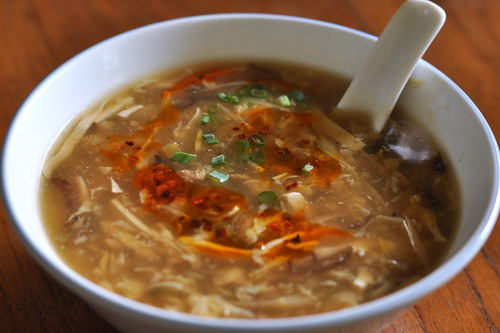
Sichuan hot & sour soup. The tofu should be cut finer--I need more practice.

Another soup, this time one of my favorites.

Remember 6th Aunt in Hong Kong, the one who fell down and broke her ankle on her way out of the dim sum restaurant when we visited last year? She's in town and I managed to get her to cook her hot and sour soup today. 6th Aunt's hot & sour soup was absolutely elegant and tasty, making mine look unrefined and, to tell the truth, it tasted coarse compared to hers.

From coarse to fine is a matter of cutting skills and patience. 6th Aunt cut all her ingredients into tooth-pick julienne strips while I cut mine as thick as chopsticks. On the tongue, the 'chopsticks' are chunky while the 'toothpicks' are delicate. To the eyes too the 'chopsticks' look unappealing while the 'toothpicks' give a foretaste of a smooth-textured soup. I also learnt from 6th Aunt's advice of not using too much ingredients so that the soup won't be like a thick bowl of ingredients in a little bit of starchy soup. That was really how my hot & sour soup tasted, because I tend to have this cooking principle of 'the more ingredients the better', which isn't true for this soup. Adequate amount of ingredients suspended in a silky tasty soup should be the key to a fabulous bowl of hot & sour soup.

Since 6th Aunt cooked without measurement, the recipe below is not rocket-science accurate, and you'll have to adjust the amount of ingredients, seasoning and thickening. Eaten with some guotie and shui jiao, this soup truly tickles the tastebuds with the texture of the many ingredients, the taste ( hot, sour and xien) and flavors (Sichuan peppercorn oil and chili oil). One of my favorite soups, not made this way in any of the restaurants here and surprisingly very well done in Chinese restaurants in the USA, from what I remember.

I have chosen to use canned chicken stock because I think the majority of us don't have home-made chicken stock sitting in the fridge whenever we feel like having quick soups as this. You can brew your chicken stock of course but that's like taking a boat to Singapore (3 days) when you can fly there (2.5 hours).

Reminder: to make a great hot & sour soup, the ingredients must be sliced very thinly and there shouldn't be an overload of ingredients!

Hot & Sour Soup Perfected (serves 6-8)
2 cans chicken stock + 2 cans water (the water is to stretch the soup but you can use stock only)
1/2 small piece of white tofu (about 1/3 cup only), outer 'skin' sliced away n cut into thin strips
3 dried mushrooms, soaked, cut into 3-4 thin layers horizontally n then into very thin strips
1/4 cup cloud's ears (black fungus), soaked, stems discarded and cut into thin strips
1/4 cup golden needles (lily buds), soaked, hard ends snipped off n buds shredded
1/2 cup chicken breast meat, in thin strips, seasoned with sesame oil, salt, pepper n some cornsflour
1/4 cup seasoned ja cai* (a pickled veg), cut into thin strips
1 small egg, beaten lightly

*seasoned ja cai comes in little foil packets

Seasoning:
white pepper (about 1 t)
black vinegar (about 4 T)--I'm told 'jen jiang' vinegar is best
light soy sauce (about 3 T)
sesame oil (about 1 t)
red chili oil to drizzle
Sichuan peppercorn oil to drizzle

To thicken soup:
4-5 T cornflour + same amount of room temp water, mixed

1. Put the chicken stock and water to boil. Add mushrooms and fungus and boil for at least 15 minutes to release the flavor of the mushrooms.

2. Add two tablespoonfuls of water to the meat to help loosen it, add meat into the soup, stirring well to separate, and then add the lily buds. When it comes to a boil, add the tofu.

3. When soup comes to a boil again, add the ja cai. Mix the light soy sauce and the black vinegar in a small bowl (this way you can control the taste better) and add half to the soup, taste, then add more if necessary. Remember that the sourness will be more pronounced when the soup cools. You can add a cup of water if the stock level has gone down.

4. Now add the white pepper (should be quite a lot but if you have sissy eaters, add less pepper and serve extra pepper on the side) and the sesame oil and when the soup is in a rolling boil, add the cornstarch solution slowly, stirring. Check if you like the consistency and add more cornflour solution or water to thicken or thin the soup respectively. Remember that the soup must be heated through to get the cornflour solution to thicken it. Switch off the heat and pour the egg in in a slow trail, stirring the soup in large circles with your other hand holding a pair of chopsticks or fork to make 'egg flower'.

5. Taste and season if necessary, then ladle into individual bowls and drizzle with chili oil and Sichuan peppercorn oil. Serve hot.

Sunday, June 28, 2009

Dried Bak Choy Soup

bak choy soup
Bak choy soup

The last batch of dried bak choy I bought from a Chinese herbal shop was so tough we couldn't chew on the veg even after 3 hours of boiling, so I decided to dry my own bak choy. I was surprised to find that the bak choy took about 10 days to dry completely. Another surprise was the that the bak choy shrank by as much as 10 times in volume. The color of the leaves were light brown, unlike the commercial ones which are almost black in color. I think the darker the color, the older the veg and that's why 3 hours of boiling didn't soften it.

Ming is a soup king. He is happy as long as he gets soup, and it doesn't matter if it's a quick soup to help wash his food down and rehydrate his system or a soup that's simmered for 3 hours to nourish his body, as long as it's a Chinese soup. Wey, on the other hand, is the only one in the family who doesn't drink Chinese soups so I have to stock up on Campbell's soups for him. Ming is very lucky that his "Australian mom" takes the trouble to cook Chinese soups just for him.

Friends who have migrated to western countries always tell me they can't make certain soup s because they can't get village chickens and regular chicken bones have an awful chicken flavor. Pork bones are the worst, smelling like what my mom said is pig pee which of course is not true but it comes close, I imagine. I think the piggy stink is because of the breed (and some say gender) and westerners expect their pork piggy so they don't mind it whereas in serious pork-eating countries (like China and anywhere you find Chinese), they rear pigs that don't have that piggy stink. If you can't get good pork or pork bones, use stewing beef or bones although traditionally this soup is made with pork. Add a small slice of ginger if using beef.

I've recently switched from using pork bones for my soup base to a cut of pork called yau moi dai in Hakka, meaning 'waist belt'. It is a piece of long lean meat covered with a thick membrane-like skin, and I'm told it is attached to the top of the tenderloin. Yau moi dai should not be cut it into small pieces; just boil it whole and cut after it's done. It will taste sweeter. The soup made with yau moi dai is just as sweet as pork bones soup with the advantage of being not oily. I've noticed that some people, especially Malaysians, add dried squid to all their simmered soups. That is so wrong. Not all traditional Chinese soups call for dried squid. In fact, sometimes the flavor of the dried squid overwhelms certain soups. Dried bak choy soup and watercress soup are two soups I can think of that don't need dried squid or dried oysters.

Dried bak choy soup is one of those old traditional favorites, cooked by moms when their families need something to cool their bodies. Many Chinese believe in heaty and cooling food--the Ying and Yang thing. Foods are heaty or cooling depending on the way they are cooked and on their intrinsic properties. Durians for example are very heaty fruits while mangosteens are cooling, and so it's best to eat both to balance the yingyang scale. Fried, roasted and bbqed food are heaty while boiled and steamed food are not. Some people are very sensitive to the heaty-cooling thing but I find it telling that our family doesn't bother much with it and so we don't suffer from heatiness or exteme coolness. It's like ghosts; the more you believe in them the more you'll see them. We have a friend who sees them everywhere and I can tell you it's very unnerving when he starts telling you who or what is in the room.

The bak choy shrank so much that I had to add fresh bak choy to the soup, but that combination makes a very refreshing soup. You can use wholly dried bak choy or add some fresh bak choy like I did. I will continue to dry my own bak choy from now on because other than the better texture and tastier soup it makes, and the fact that my choy is organic, home-dried bak choy has none of the slight sourness that commercial dried bak choy sometimes give. There's so much fiber in this soup, you'll feel very detoxed the next day.

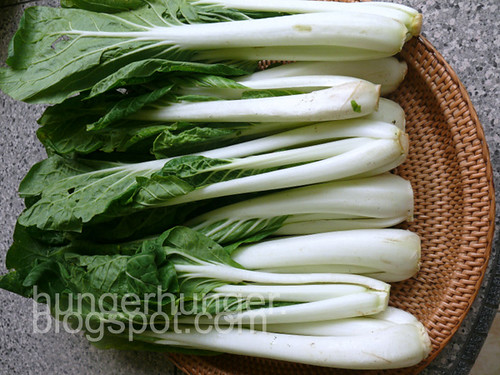
bak choy
Fresh bak choy. To make your own, get the long-stemmed bak choy, wash well and hang them on a line to dry. When wilted, you can put on a metal tray or bamboo tray to dry. Dry it in hot sun until it is like straw.

bak choy 1
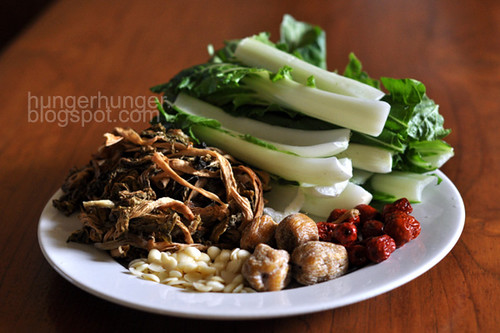
The ingredients for bak choy soup--I used 3 x as much fresh choy than shown in the photo. This is the amount of dried bak choy I got from the fresh choy in the previous photo.


Dried Bak Choy Soup (for 8-10 servings)
700-800 kg pork meat or 1 kg pork bones, or mixture of
a handful of dried bak choy (say 1 cup, compacted), soaked, washed n cut into 6 cm lengths
300-400g fresh bak choy, cut into 6-8 cm lengths
1 small handful red dates, washed
4-5 honey dates, preferably the sugar-free ones (if unavailable, substitute with ordinary dates)
2 T Chinese apricot kernels (for soups), washed
salt to taste, if using

1. Clean the pork meat or bones, then blanch them with boiling water and drain.

2. Put the meat/bones into a large pot and add enough water to give about 8 cm clearance from the ingredients to the water level. Add the red dates, honey dates, almonds and dried bak choy and let soup simmer 1 hour.

3. Add the fresh bak choy, season with salt lightly and simmer another hour (I don't believe in simmering for longer than 2-2 1/2 hours, unlike my MIL who simmers her soups for 3-4 hours). Do not add more water unless the water level is very low. Serve hot.

Thursday, June 25, 2009

Bubur Cha Cha

bubur chacha
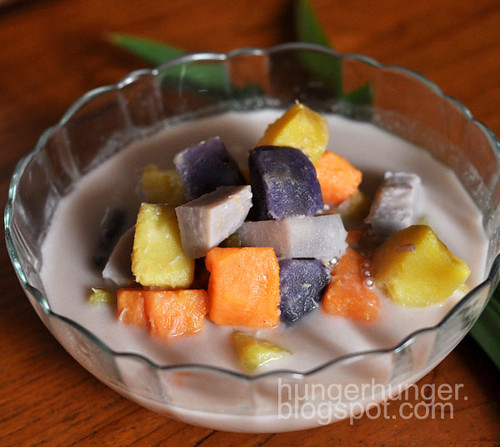
Bubur cha cha, a simple yet yummy dessert of colorful sweet potatoes and taro cooked in coconut milk.

Ming is home and the family is complete. Not counting 1 1/2 years ago when we were in Melbourne for Yi's graduation, our family has not been together for 2 years, so this is a wonderful time. I feel the difference in my 2 older kids. They aren't teens anymore. I feel relieved and a little sad about that.

Ming was telling me about a popular show in Aussieland right now, Master Chef. In one of the episodes, an Asian contestant boiled sweet potatoes in coconut milk and the distinguished judges--professional chefs--were amazed with his cooking creativity and skills. It was hilarious, said Ming. Every Asian knows that dessert. In Malaysia, it's called bubur cha cha. The Thais use pumpkin, Viets add bananas to the sweet potatoes and Indonesians like their bubur cha cha with colored glutinous rice balls.

We get sweet potatoes in white, yellow, orange, light purple and dark purple. To me, there are 3 essential ingredients to making a fantastic pot of bubur (a Malay word for thick soup or congee) cha cha and they are pandan leaves, taro and fresh thick coconut milk. I sometimes make bubur cha cha the Chinese way, like my dad, with sweet potatoes, taro, fresh ginger and brown sugar but that will give a nice, refreshing dessert. Pour in some santan or coconut milk and it turns the dessert from nice to awesome. Santan is to Asia what dairy cream is to western countries. We add santan to soups, veg, drinks, curries, our pancakes, our kuihs, our cakes and our jellies. When it comes to santan, especially for desserts, I am very stubborn: it has to be fresh santan, straight from the coconut. For cooking savory dishes such as curries, I may use canned santan but that is only if I really can't get fresh grated coconut, which is unusual because they are found in most grocers.

You can add large sago pearls to the bubur but I find it a bother to have to cook them separately so I always use the tiny sago pearls. Sago pearls thicken the bubur and are fun to eat and look at (they turn totally transparent). One mistake I always used to make was cooking the sweet potatoes and taro for too long. I've found that it only takes 10 minutes to cook these tubers until tender. Immersed in a pot of hot liquid, the potatoes continue to cook even after the heat is taken off and by the time the bubur is cool, the potatoes are usually mushy and all broken up. Bubur cha cha tastes best when you let it sit a while after cooking, so the best time to eat it is when the bubur is lukewarm.

Note: I checked Nee's post on bubur cha cha and she steams her sweet potatoes and taro until they are tender and then add them to the boiled santan/coconut milk. This way the potatoes will not be too mushy (ensures perfect texture) but their flavor will not be infused into the santan so it's up to you what you want.

bubur chacha1

Bubur Cha Cha (makes a huge pot)
2 kg mix of sweet potatoes and taro
grated flesh of 3 coconuts
5 pandan leaves
sugar to taste
1/2 cup tiny sago pearls

1. Peel and cut the potatoes and taro into 2.5 cm chunks. Wash and tie the pandan leaves into a knot. Add 2 cups of room temp water into the grated coconut, 'massage' and knead the coconut so that the milk released is thick (sometimes called coconut cream). Squeeze out the milk and strain it into a large bowl. Add 1 liter of room temp water again to the grated coconut, massage and knead again. Squeeze the thinner milk through a sieve into the thicker milk. Put aside.

2. Put the pandan leaves into a large pot (doesn't have to be a thick-base pot because it retains too much heat) and add 1 1/2 liter water to boil for 10 minutes. Remove the leaves.

3. Now add the unwashed sago, sweet potatoes and taro, stirring well to mix. Add enough water if necessary to just cover the potatoes. Add enough sugar to just sweeten the soup; not too much because the milk will add more sweetness. Let the bubur simmer for another 5-7 minutes (stir once in a while) and then add the milk. When the bubur heats through but not boil, switch off the heat and let it sit covered for about 10 minutes. The sago pearls may still have some white uncooked starch in their center but this will turn transparent as the bubur cools.

You can add a pinch of salt if like but I think it's good not to salt everything, especially soupy desserts.

Tuesday, June 23, 2009

Fried Assam Laksa

laksa
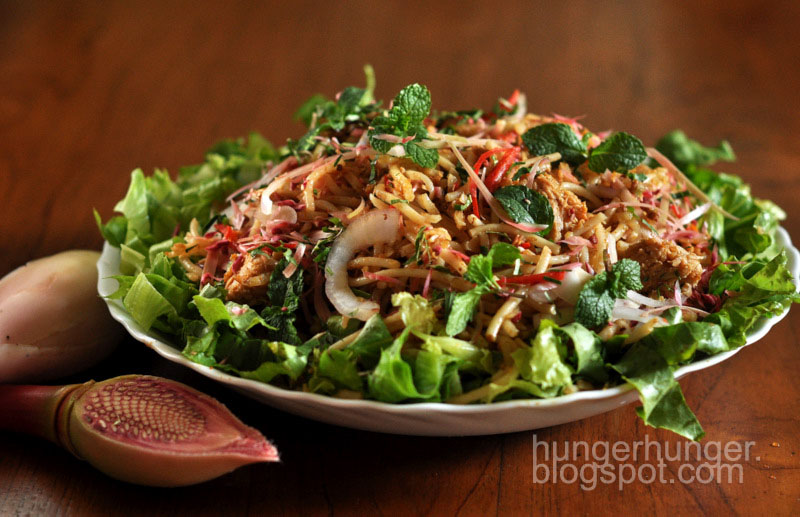
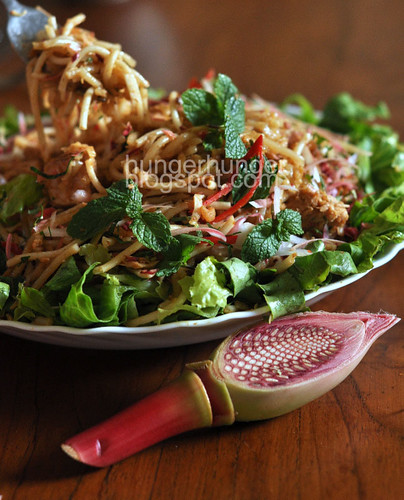
Fried assam laksa noodles

Is it just me who has never heard of fried assam laksa? I love Penang assam laksa, and even flew to Penang last year just to eat it. When I saw the recipe for fried assam laksa in a recent copy of Flavour magazine, I knew I had to cook the dish.

It is VERY hot and dry in KK now, and bunga kantan (kantan flowers, known as torch ginger buds for their shape) are aplenty in our markets. I love the scent of these buds, so much that I'm going to have a bunga kantan plant in my garden if I can get hold of one. Bunga kantan is an essential ingredient for making assam laksa. Without it, it is like Hokkien mee without pork crackling and pork oil. If you can't get your hands on some, you shouldn't attempt this dish. But poor you, you'll be missing out on a fantastic noodles dish. I think this dish will be a hit at pot luck dinners and gatherings, and unlike the original Penang assam laksa, this dish doesn't require as much work.

Asian dishes are very colorful and flavor-centered, and fried assam laksa has about 10 different highly scented and flavored ingredients that not only satisfy your tastebuds, but also your nose and your eyes. I have made quite a bit of adjustments to the original recipe, starting with the noodles. We just can't get fresh assam noodles here. Even dried assam noodles are hard to find. I think a good substitute would be what we call 'mouse noodles', those short rice noodles with a tapered end. I also added extra ingredients such as belacan, sweet shrimp paste, canned tuna, daun kesom and mint. These are basically the same ingredients used in the traditional assam laksa. Instead of mixing in and frying the traditional garnishing of cucumber and onions, I used them as garnishing and added bunga kantan, bombay onions, red chili and cucumber, as in traditional Penang assam laksa. What I missed out and will add next time I cook this is pineapple bits. That will really jazz this dish up and help blend all the different flavors. The ingredients list looks scary but it was okay for me because I grow most of the ingredients in my garden.

This noodle dish reminds me of Siam noodles, but it has even more intense and varied flavors. It also is very healthy since only a small amount of oil is used for frying and there are lots of fiber in the herbs and veg. We ate the whole plate of noodles for tea, the 4 of us. I nearly licked the plate.

laksa1

Fried Assam Laksa
400 g dried assam laksa noodles, soaked in room temp water for 2 hours (or about 1 kg fresh)
1 large bunga kantan, sliced very very fine, divided into 2 parts
1/2 bulb garlic, minced
5 shallots, sliced
2 stalks of lemon grass (serai), the 'heart' sliced very finely
1/2 cup dried shrimps, soaked until soft, drained and chopped
1 can tuna chunks or flakes
1 x 40 g (about 2 T) pkt tomyam paste (I used Adabi brand)
1-2 t belacan
1 T sweet shrimp paste (hae ko)
juice from 3 limes or 1/2 cup thick assam water (or a mixture of)
1 t chicken stock powder
1/2 cup water (if using dried noodles &/or limes instead of fresh noodles &/or assam water)
3 T veg oil

garnishing:
1/2 the bunga kantan
1 Bombay onion, sliced into half rings
1 small stalk of lettuce, washed & sliced into 1 cm shreds
1 small Lebanese or Taiwanese cucumber, julienned
1 red chili, in thin strips
4-5 chili padis (optional)
1 cup pineapple, in small chunks
4-5 daun kesom, sliced into very very very thin strips
a small handful of mint

kasturi limes to serve with

1. Put oil into a heated wok and add the garlic, shallots and dried shrimps. Fry until lightly browned/golden, add the tomyam paste and belacan, stirring well to mix.

2. Add the shrimp paste and water/assam water if using. Add the chicken stock, stirring well.

3. Add the noodles and stir fry with a ladle and pair of chopsticks, taking care not to cut or break the noodles.

4. Now add the lemon grass, 1/2 the bunga kantan and lime juice (if using instead of assam water) and season with salt if necessary. If noodles are too hard, add some water.

5. Arrange the lettuce on a large plate or bowl, ladle the noodles over the lettuce and top with all the remaining garnish. Serve with kasturi limes on the side.

Thursday, June 18, 2009

Yakitori Chicken

yakitori-1
Yakitori chicken

I've not been that busy, but I've certainly been lazy. On the pretext of taking my daughter (the 'pearl in our hand', as somebody described it, is back on winter break) out to eat her fav food, I've not been cooking except for Wey who has tuition at night and can't come out with us.

Talking of tuition, I was disappointed and dismayed after talking to Wey's English teacher yesterday. Wey and I had a big argument a few weeks ago when I sat him down to work on his English. For his PMR exams in Oct, Dr Jekyl and Mr Hyde is one of the two books he has to cover, the other being Robinson Crusoe. He claimed that they haven't been asked to read the novels; he doesn't even have a copy of the novels. What they are using this year is two workbooks on Dr Jekyl. School just started Monday, so I went to the teacher who confirmed that the kids aren't required to read the novels because by the time they go through the workbooks, they'd know how to answer the questions. When I protested, she said they have no time (didn't they have 3 years, Form 1 to 3? And the novels, used by other schools, are in very simple English which a primary school kid would have no difficulty reading?) to read the books because the classes are big, the kids cannot be bothered, there are too many other subjects to cover and literature makes up only 10% of the total score. She then advised that I can always send my son for tuition. I was stunned. I don't think I endeared myself to her, because I told her as graciously as I could that if I was teaching, I'd make sure all the students read the novel first because what is the point of teaching literature if the students are not taught to appreciate the beauty of the language, the story, the prose? Her final word was that what everybody wants is to get high marks in exams so the school caters to that want. And so I rest my case, that education in Malaysia has gone to the dogs. I don't blame the teachers as much as I blame the schools and the Education Dept and parents, those who insist on all As, who regard any grade less than an A as a loss of face. Education here isn't about knowledge, it's about how many As the students can score. It isn't about learning important and relevant useful subjects because if it is, then students won't have to struggle with 11 subjects (12 if you do Chinese), of which the three subjects morals, civics and life skills, as far as I am concerned ARE A BLOODY WASTE OF TIME. Make that four subjects, because history is also a waste of time since it is 90% Malaysian history made up to brainwash the kids on the monarchy, our founding fathers and the government. If I am the Education Minister and I am truly concerned about education, I would review the present syllabus without any agenda but with a single-minded goal to make education truly meaningful, enjoyable and knowledge and skills-acquiring rather than score-seeking. Besides those 3 or 4 subjects, I would also throw out geography too, and replace all of them with a new subject that emphasizes geography, geo science, environmental science and ecology. This is what the future generation needs to know, the limitation of the earth's resources and how we should manage and preserve them, instead of where rubber trees are planted in Malaysia and the names of the tribal dances and different musical instruments of the natives.

So to the Chinese who are fighting to teach Science and Math in Chinese, and the Malays who want those two subjects in Malay, I say "Boot to the Head". The whole education system is rotten and we are fighting about teaching those subjects vernacularly.

Okay, that's some huffing I've done. If you still want food, here's what I whipped up for Wey's dinner tonight: yakitori chicken. If I had the time, I'd have skewered some shiitake mushrooms, bell peppers and even chicken livers, which is popular in yakitori joints in Japan. You do need a very hot grill for yakitori or you'll end up with a skewer of steamed meat. Make the sauce well ahead because you'll need some sauce to marinade the chicken with.

I think I need some leong cha to cool my head.

DSC_0260
Yakitori Chicken
300g chicken thighs
2 stalks of leeks
wooden skewers, soaked in water 30 minutes
teriyaki sauce

1. Cut the chicken (with or without skin) into 4 cm squares, the leeks into 4 cm lengths.

2. Use 2 T of the teriyaki sauce to marinade the chicken for at least an hour.

3. Skewer the chicken and leeks alternately. It's good to start and end with a piece of leek because it holds the meat in.

4. Fire up that grill and grill the chicken on low heat for about 2-3 minutes each side, then increase the heat to high and baste with the teriyaki sauce for another minute or two. Be careful not to burn the chicken; the sugar in the sauce can burn easily and taste bitter. Serve with rice, or better still, with beer.

Teriyaki Sauce
1/4 cup mirin
1/2 cup sake
3 T sugar
1/4 cup light soy sauce
2 pinches of dashi (optional, but I like the extra umami taste)

Put everything except the dashi into a small pot and simmer over low heat for about 30 minutes (add the dashi towards the end of cooking) until sauce is thickened. Remember that the sauce will thicken further upon cooling. I got about 5 T sauce for this recipe.
Related Posts Plugin for WordPress, Blogger...