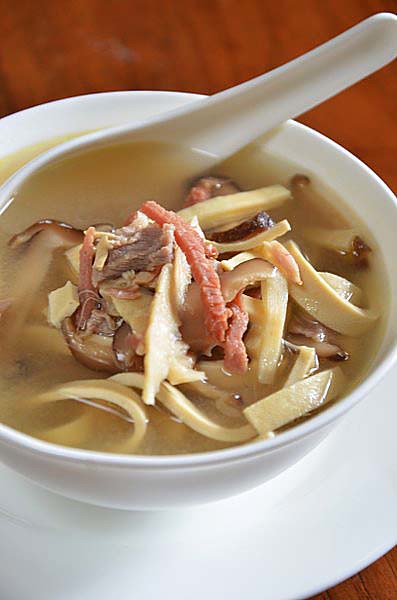
 Shanghainese gunxi tang.
Gunxi tang is bean curd strips soup, and it's always on the menu in authentic Shanghainese restaurants and the ingredients are usually cut finer than we do at home. We can't get thick bean curd sheets here and there's no substitute but just in case you get your hands on some of the real stuff, do make this soup. My Hub was in Shanghai two weeks ago and all he brought back was different kinds of bean curd sheets. I've frozen them in little packs so they should last until somebody else brings more over.
My Hub averages 4 to 5 bowls each time his mom or I cook it! Ok, more when his mom cooks it but it's okay, I'm cool about that. I admit to 2 bowls myself although given the choice, I prefer yindooxin, another famous Shanghainese soup made with nearly the same ingredients except for the soup base and the cured meat, salted pork and pork bones for yindooxin and chicken soup and Chinese ham for gunxi tang.
It's late and I still go to bed past midnight even though I made a resolution to go to bed early and wake up early once I get started on my new venture. Old habits don't die hard, they just don't die!

Cut the ingredients finer than this for a better-looking soup.
Shanghainese Gunxi Tang/Bean Curd Sheets Soup (serves 4 to 6)
350 gm thick bean curd sheets
150 gm lean pork (or not so lean, up to you)
150 gm young bamboo (preferably fresh winter bamboo)
20 gm (or more, if like) dried Chinese mushrooms, soaked until soft, stems removed
100 gm Chinese ham (blanched with boiling water)
3 liters home-made chicken stock (I used organic home-reared kampung chicken)
1. Wash the bean curd sheets and cut into fine strips. The finer the strips, the more refined the soup. Restaurants arrange the ingredients neatly in a claypot and steam the soup. Cut pork, mushrooms, bamboo and ham into fine strips too.
2. Put the chicken stock (if using whole chicken, boil for an hour, remove the chicken & use the stock) to boil in a large enough pot. Add the bamboo and mushrooms and boil at medium heat for 30 minutes.
3. Add the bean curd strips and boil gently for 15 minutes, then add the pork (stir well with chopsticks to separate) and boil 10 minutes. Add the ham, stir well and let it come to a boil for a minute. Taste and season with salt if needed. Serve hot, with black vinegar if like.
|

Showing posts with label SoupsNSauces. Show all posts
Showing posts with label SoupsNSauces. Show all posts
Wednesday, September 19, 2012
Shanghainese Gunxi Tang/Bean Curd Sheets Soup


Friday, April 13, 2012
Yindooxin
(This is a scheduled post)
I've mentioned yindooxin so many times but never blogged about it because I've never cooked it myself until recently. My MIL cooks this soup whenever visitors from Shanghai bring her the beancurd sheets.
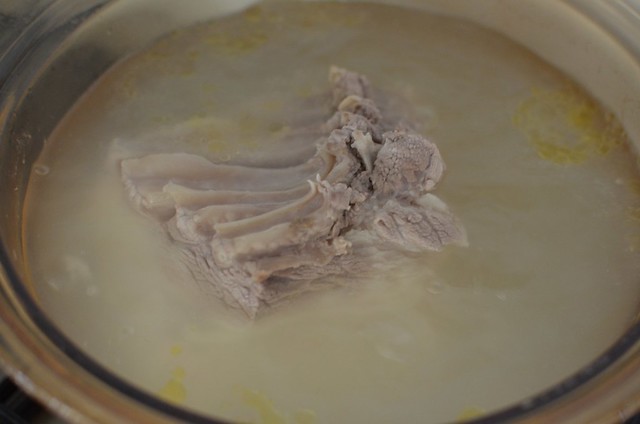
I used the stock from boiling the pork belly for hong sao ro. This is also the same stock I boiled the chicken for the salty chicken. I cooked a Shanghainese feast when I got back from SH.
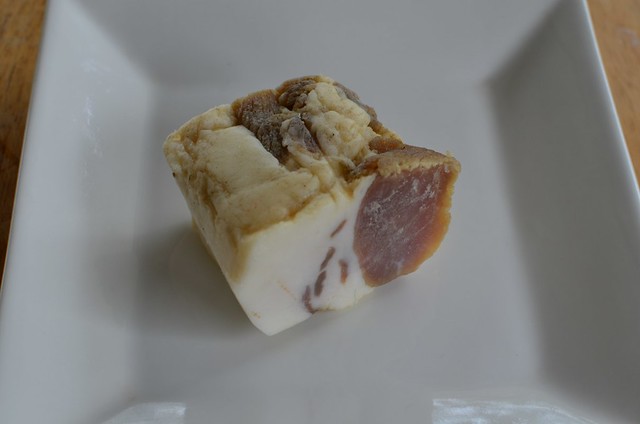
Xian ro (salty pork) is the right meat for yindooxin but for a stronger flavor and richer taste in the soup, you can use Chinese ham.

You can slice the cured meat or leave in chunks.

Fresh bamboo shoots. Cut into small chunks.

Fresh beancurd sheets come in 3 sizes--thin, medium and thick. Ahyi had bought me a mixture of thin and medium sheets. The thin sheets are easier to tie into knots. The medium sheets tear easily so I cut them into wide strips although the right way is to tie the beancurd into knots as above.
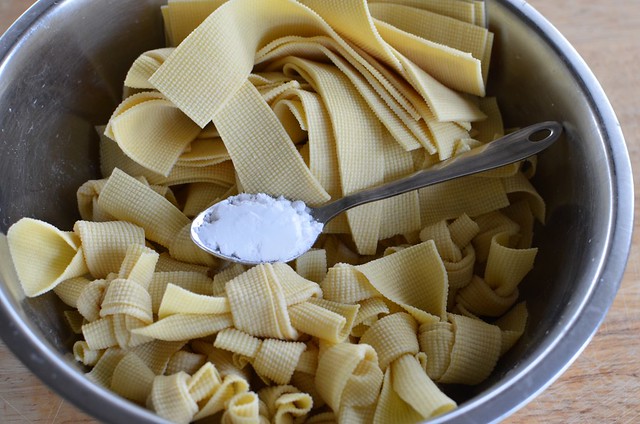
A teaspoon of bicarb of soda and ...

hot water will soften the beancurd sheets. Leave for 15 minutes and then drain and wash once. Do not leave for too long or the sheets will become too soft.
Yindooxin (serves 10)
1. Simmer a whole pork leg or pork belly in a large pot of water for an hour. For a less rich soup, use lean pork bones. Blanch the pork or bones with boiling water first to remove any hair or smell. The soup smells better with some Shaoxing wine added now but traditionally, no wine is added. About 3 to 4 tablespoons should do it.
2. Add the bamboo shoots (cut into small chunks). If using ham or pork in chunks, put them in too. A 6cm square chunk cut into 3 is enough. Simmer another hour. If using sliced ham or salty pork, put them in later, when the soup's been boiling about 1 1/2 hours.
3. The pork should be quite soft now. If you prefer the pork to be softer, let it simmer longer. When ready to serve, add the beancurd knots. When the soup comes to a boil again, let it boil another 3 to 5 minutes before turning off the fire. Season with white pepper. Add salt if necessary--the ham/salty pork usually is good enough. Serve hot with some finely cut spring onions.
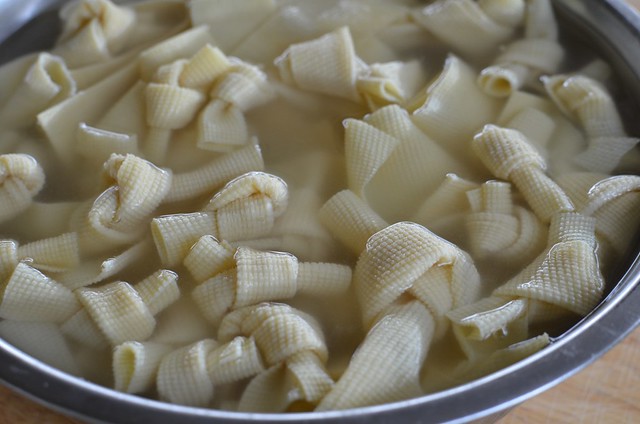 The beancurd knots will be softer and lighter in color.
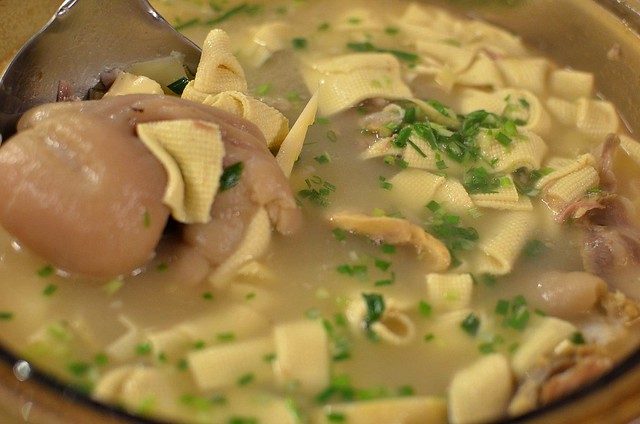
Yindooxin--a rich comfort soup for the Shanghainese.
I used the stock from boiling the pork belly for hong sao ro. This is also the same stock I boiled the chicken for the salty chicken. I cooked a Shanghainese feast when I got back from SH.
Xian ro (salty pork) is the right meat for yindooxin but for a stronger flavor and richer taste in the soup, you can use Chinese ham.
You can slice the cured meat or leave in chunks.
Fresh bamboo shoots. Cut into small chunks.
Fresh beancurd sheets come in 3 sizes--thin, medium and thick. Ahyi had bought me a mixture of thin and medium sheets. The thin sheets are easier to tie into knots. The medium sheets tear easily so I cut them into wide strips although the right way is to tie the beancurd into knots as above.
A teaspoon of bicarb of soda and ...
hot water will soften the beancurd sheets. Leave for 15 minutes and then drain and wash once. Do not leave for too long or the sheets will become too soft.
Yindooxin (serves 10)
1. Simmer a whole pork leg or pork belly in a large pot of water for an hour. For a less rich soup, use lean pork bones. Blanch the pork or bones with boiling water first to remove any hair or smell. The soup smells better with some Shaoxing wine added now but traditionally, no wine is added. About 3 to 4 tablespoons should do it.
2. Add the bamboo shoots (cut into small chunks). If using ham or pork in chunks, put them in too. A 6cm square chunk cut into 3 is enough. Simmer another hour. If using sliced ham or salty pork, put them in later, when the soup's been boiling about 1 1/2 hours.
3. The pork should be quite soft now. If you prefer the pork to be softer, let it simmer longer. When ready to serve, add the beancurd knots. When the soup comes to a boil again, let it boil another 3 to 5 minutes before turning off the fire. Season with white pepper. Add salt if necessary--the ham/salty pork usually is good enough. Serve hot with some finely cut spring onions.
The beancurd knots will be softer and lighter in color.Yindooxin--a rich comfort soup for the Shanghainese.
Thursday, November 24, 2011
Kim Chi Veg & Beef Soup

I'm sorry for the quality of these photos. I don't know how to take night photos yet don't like the harshness of the flash, and I didn't want to turn dinner into a photo shoot session.
I hardly watch TV. It's not that I don't have time. I just can't sit still in front of the box for long although I've done marathon sessions on the couch until 3 am for consecutive days watching Korean and Chinese TV series. Once in a while I'd catch some interesting program, standing up. The other day, I was walking by the TV room and the dish on a Taiwanese cooking program was sour cabbage soup with thinly-sliced sirloin. Since sour cabbage is not a common ingredient here, I thought kim chi would be a good substitute so last night this was what I cooked:
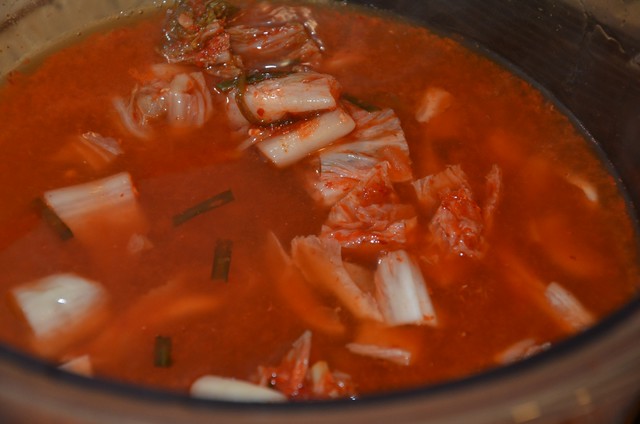
1. Put a cup of sliced kim chi into a claypot or glass/ceramic pot. Add enough chicken stock (or water + 1 chicken stock cube) to cover.

2. Add sliced Chinese napa cabbage, cover and boil about 10 minutes or until cabbage is nearly the texture you like.

3. Add two sliced potatoes. Cover and boil 5 minutes.

4. Meanwhile, sear 1/2 kg thinly sliced (these weren't thin enough) sirloin on both sides quickly. Sear the beef in several batches, each time using about 1 tsp butter. Do not cook through. Remove onto plate.

5. Add about 2 cups soft or semi-soft tofu to the soup, scattering them over the soup evenly.
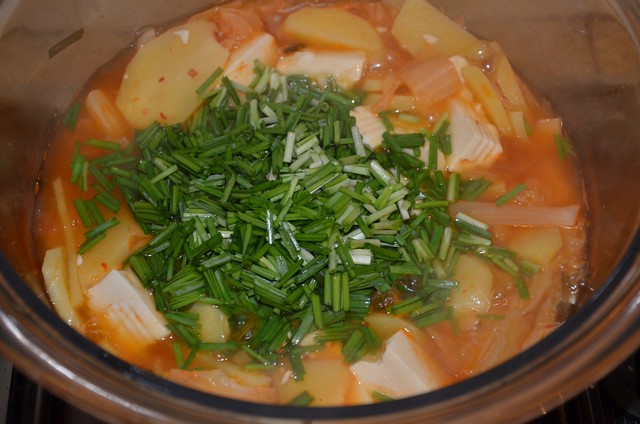
6. When the tofu begins to boil, add 1 cup of chopped chives (these were from my garden. Chives are perennial so do grow some at home), spread them over evenly and cover. Taste and season with salt and white pepper.
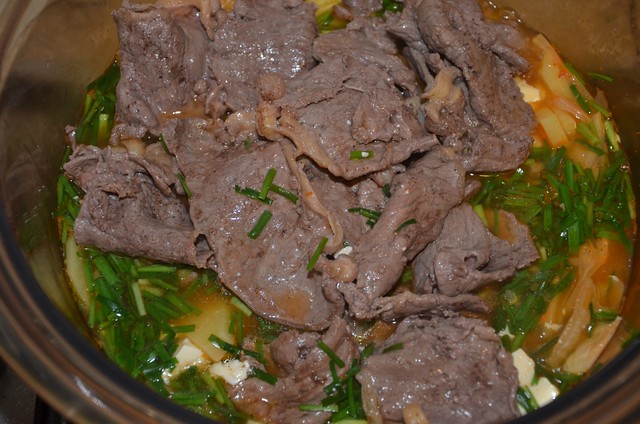
7. When the soup boils, switch off the heat and add the seared beef. Serve the whole pot at the table.

8. Drizzle some chili oil on the soup and eat with plain boiled rice and another dish, such as a fried fish dish.
Wey pronounced the soup perfect and motherhood was worthwhile again.
Btw, Wey said MasterChef Malaysia is an awful and embarrassing show. Any thoughts, anyone who has seen it because I haven't. I watched Hell's Kitchen for the first time last week and I enjoyed it and was happy that Paul, the underdog, won. To be honest, I avoid reality food shows because they are so...staged. I've only watched MasterChef Australia once, the finals between Callum and Adam, and I only watched it because my friend Elaine kept calling me when the show about to start so we sort of watched it together in our own houses but with our handphones to our ears. Guess who got all the answers right? Wey. He named all the fruits and sauces (except for Romesco sauce, if I remember right) and he didn't even have to taste them!
Tuesday, August 9, 2011
Spicy Red Lentils And Barley Soup
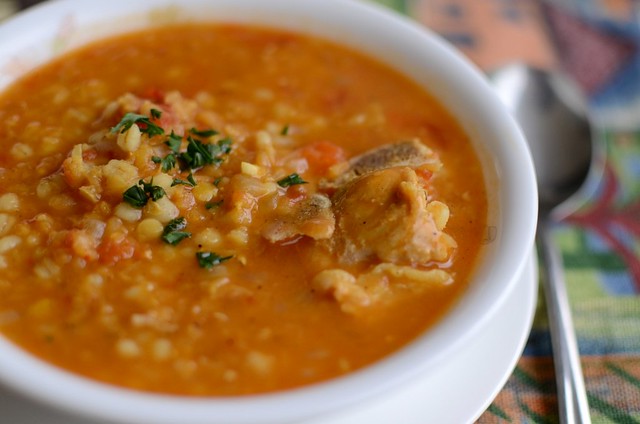
I wanted a bowl of congee for lunch but my friend E suggested lentils soup at her house. Er. The only lentils I eat is dhall gravy served with roti canai. How good can lentil soups be.
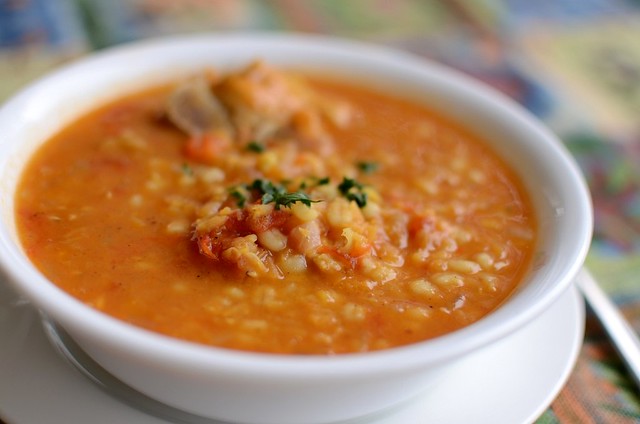
So good. So very good that I wanted to shout it from a mountain top. Delicious, nutritious and complete, this soup will from now on be a staple in my house, especially on cool days (some snow would be nice). The cumin, tumeric and curry powder gave this soup an exotic North African (or is it Middle-Eastern) flavor and I was reminded of a soup I ate in Melbourne last year although E's soup was wayyyy tastier.
Lentils, dried beans and whole grains are not big with the Chinese, or at least the Cantonese Chinese. I didn't grow up eating them. The only dried beans I ate growing up was red beans (azuki beans), black eyed peas/beans, green beans (mung beans) and black beans. I like to cook a mixed dried beans soup which my family loves and sometimes, when the weather is hot, a sweet mung bean lily bulb soup to cool the body. When I feel that my body lacks energy, I cook red bean soup because my mom said that red beans fortify the blood, likely because of their high iron content.
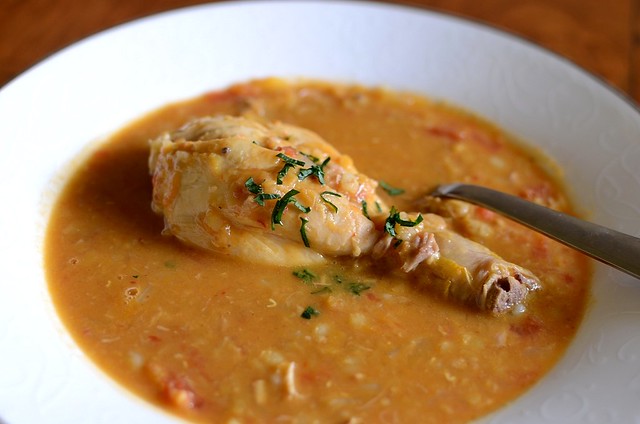
If your family is carnivorous like E's, you can add some chicken drumsticks or pork chops to the soup although without the meat the soup is just as good. Served with slices of crusty bread, this soup would make a very hearty, nutritionally balanced meal. The basic recipe is awesome but feel free to add veggies such as celery, potatoes and carrots. As with all long-simmered soups, this soup tastes better if allowed to sit for at least an hour and reheated just before eating. Perfect soup for those on a liquid fast.
1 T veg oil
1 large onion, chopped
2 cloves garlic, crushed
1/2 t tumeric powder
2 t curry powder
1/2 t ground cumin
1/2 to 1 t chili flakes or paprika
6 cups water
1 1/2 cups veg or chicken stock
1 cup red lentils
1/2 cup pearl barley
400 g can diced tomatoes
salt & pepper to taste fresh parsley or coriander, chopped
optional but recommended : 1 kg meaty pork bones or chicken
note: 1) if you are adding bones, you can add another 2 cups of water and additional 1/4 cup lentils.
2) you can sub the can of chicken stock with a can of tomato soup, and use 3 to 4 large ripe tomatoes instead of canned tomatoes.
1. Heat oil in a pot, add onions and cook gently 5 to 10 min or until soft and beginning to brown.
2. Add garlic, tumeric, curry, cumin & chili flakes and cook, stirring 1 min.
3. Stir in water, stock, lentils, barley, tomatoes, salt and pepper to taste. Cook about 30 minutes. If adding bones, add the bones now and the lentils about 20 minutes later (because they break up faster) and simmer another 30 minutes. That means altogether about 50 minutes with bones. Switch off the heat and let the soup sit and develop the flavors. Reheat just before serving.
4. Garnish with chopped parsley or coriander.
Thursday, April 28, 2011
Pumpkin Soup
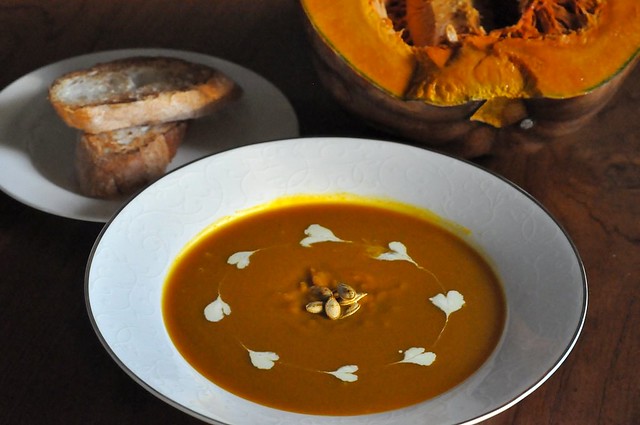
We had a couple of pumpkin vines in our back yard and there were so many pumpkins that the people I gave them to refused my second round of the bounty so we've been eating a lot of pumpkin with dashi and pumpkin soup, the only ways I cook pumpkin. I found the last pumpkin among the leaves of my mango tree. It had dropped off from the vine but was still hanging by the string that held it to the tree. I don't know how long it had been there but the pumpkin when cut was a deep orange color, exactly the way I like my pumpkin. A deep orange pumpkin guarantees sweet, fluffy and fragrant pumpkin flesh and plenty of beta carotene, an antioxidant that is converted into vitamin A in the body.
One of my best loved cook book is San Francisco's Cooking Secrets by Kathleen DeVanna Fish from which my best recipes are adapted, including a yolkless tiramisu which has no comparison. There are no photos in the book but it is filled with recipes for simple, elegant dishes from the top restaurants in San Francisco.
The winter squash (such as butter squash and pumpkin) soup in the book is a quick two-step recipe but makes the best pumpkin soup ever. The recipe doesn't say how much pumpkin ("a large butternut squash") so I use quite a lot so that the soup is real thick and rich without the need for lots of cream. I find the one tablespoon of ground cardamon in the original recipe too over whelming and prefer to add it in small amounts until I get the right spiking. I also reduced the butter from 3 tablespoons to a healthy 1 tablespoon only and instead of adding one cup of cream to the soup, I serve the cream separately because the soup without cream is already heavenly. A couple of slices of toasted baguettes and this soup makes a great simple snack or light lunch.
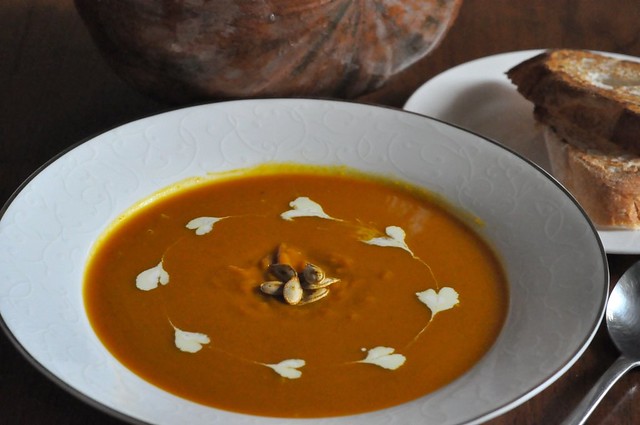
Winter Squash Soup
800 gm to 1 kg pumpkin
1/2 brown onion, chopped
1 T butter
500 ml chicken stock (Swanson's)
1/8 t freshly ground cardamons
salt & freshly ground pepper
cream
1. Peel and cut pumpkin into small pieces. In a medium-sized pot, fry onions in the butter until the onions are soft. Add the pumpkin and cardamon (sparingly and to taste), stirring well. Add the stock, cover and simmer 15 minutes or until pumpkin is soft.
2. Use an electric hand blender to puree the soup. If too thick, add some water or stock. Season lightly with the salt and pepper. You can either add 1 cup of heavy cream now or serve it separately.
Tuesday, January 19, 2010
Ming's Beef, Mushrooms & Mixed Beans Soup
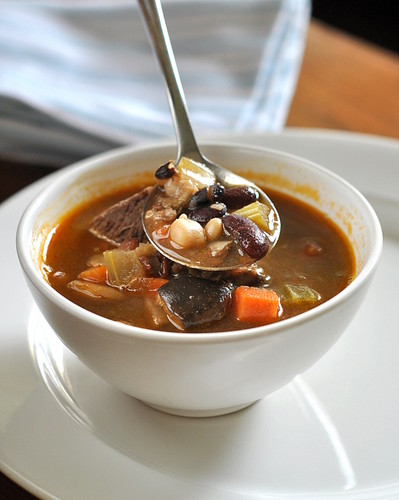
Beef, mushrooms and mixed beans soup
I really like our weather the past several days, with cloudy skies, light rain and cool afternoons of around 25 C and colder at night, the coolest days we've had in years. The only problem I have with such nice weather is the floods in the rural areas. Those in dreary grey places will not understand but if you live in hot sunny weather 365 days a year, you'll welcome the rain and clouds like the Brits welcome the sun.
This started out as 'beef & barley soup with mushrooms and dill' from a copy of Australian House & Garden but because Ming preferred mixed dried beans to barley, because shiitake mushrooms are cheaper than button mushrooms (he loves mushrooms) and sherry reduced with the onions is one of his fav cooking secrets, he came up with a different soup but one that was so superb we (except for Wey, who probably is planning to run away from home soon--we've had a pork-free week) didn't eat anything else but the soup for dinner last night. The only thing you can't omit or substitute though is the dried porcini mushrooms which gave the soup that special savory flavor.
Stews and thick soups always taste better the next day when the ingredients have been given time to absorb the liquid and flavor, and the soup infused with the ingredients. If possible, cook the soup the night before but I don't think that'll work because honestly who keeps freshly cooked soup for the next day? So the next best thing to do is cook this ahead of time, say hours before dinner. And if your family is like mine, always trying to loose some weight, all you need with the soup is some crusty bread.
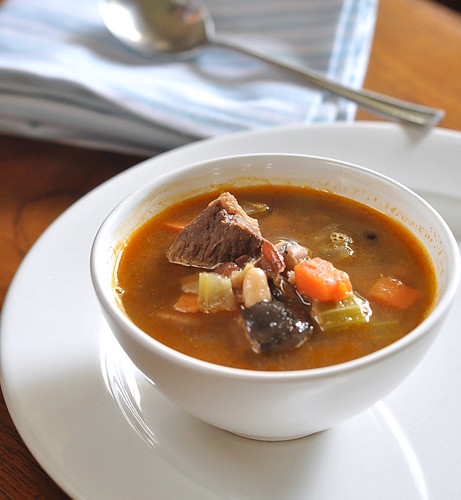
Ming's Beef, Mushrooms & Mixed Beans Soup(serves 8-10)
1/3 cup dried porcini mushrooms
2 T extra virgin olive oil
2 T sherry
1 kg chuck or rump steak, in 2 cm cubes
2 brown onions, chopped
2 large carrots, in 1 cm cubes
2 stalks celery, 1/2 cm slices
150 g button mushrooms, quartered
150 g shiitake mushrooms, in 1.5 cm pieces
1/4 cup tomato paste
1 can beef stock
2 l water
2 1/2 cups mixed dried beans, washed well* (chick peas, butter beans, kidney beans etc)
2 bay leaves (in place of 1/4 cup fresh chopped dill)
salt & freshly ground black pepper to taste
* you can use 2 cups pearl barley instead
1. Put porcini in a small bowl and add 3/4 cup hot water to rehydrate it for about 20 minutes. Pick through the softened porcini to remove any dirt and drain the soaking water through a sieve lined with a damp paper towel to remove any grit. Keep the liquid.
2. Heat up a heavy based pot and add the oil, then the beef cubes and let it sear all over and remove. Add the onions, carrot and celery and cook 10 minutes under low heat (have patience) until softened. Now add the sherry, stir for 15 sec. Add the porcini and the other mushrooms and stir for 5 min.
3. Stir in the tomato paste, stock, water and porcini soaking liquid. Bring to a boil, add the beef and bay leaves. Simmer, with lid slightly at angle, for 1 hour.
4. Add the beans and simmer another 1 hour 30 minutes, stirring from time to time. Turn off the heat and let soup sit for at least 45 min and then heat soup up again. If the soup becomes too thick, add some water. Season with salt & pepper to taste.
Wednesday, October 14, 2009
Shanghainese Winter Melon Soup
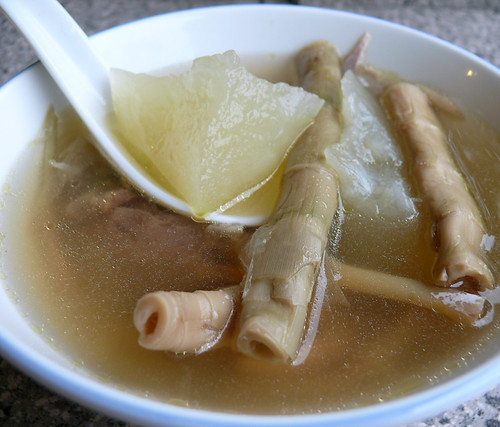
Shanghainese winter melon soup
Some of the most popular Chinese soups I can think of are lotus root soup, winter melon soup, white carrot soup and watercress soup. These soups, which are simmered for at least 2 hours, are served in most restaurants. Every respectable Chinese housewife should be able to not just cook these soups, but cook them them well.
Chinese soups are easy to cook. Everything goes into the pot to be simmered for at least two hours or about four hours if it's double-boiled (soups are double-boiled in a ceramic tureen or crock which sits in a pot of water so the heat is indirect and very gentle, just like a bain marie). The Cantonese believe that 'long-boiled' soups invigorate and rejuvenate the body and people who have recovered from illness are made to drink lots of double-boiled soups.
Winter melon soup is one of my favorite soups, especially if the melon is the pandan-flavored winter melon. The whole house can be scented by the fragrance of the melon as the soup cooks. The most common way to cook winter melon soup is to simmer the soup with red dates, salted turnip and meat or bones, and the Cantonese will add a small handful of dried oysters although if a less robust but more refreshing soup is preferred, the dried oysters can be omitted. The Shanghainese winter melon soup is just as simple, but instead of dried turnip, salted young bamboo tips called "beeji" in Shanghainese and "bian jian sun" in Mandarin are used and Chinese ham replaces dried oysters. I've not found beeji in KK but they are found in Asian grocers in Australia and they keep well in the fridge. My daughter loves beeji like a dog loves bones. She's a true Shanghainese; they love bamboo. Beeji is crunchy-tender and fun to eat. It almost takes the limelight from the winter melon. I dig for the beeji in the pot more than I do the winter melon.
If you want a lighter, refreshing soup (Chinese soups are supposed to be such, to wash and clean the palate for the many varied dishes in a typical Chinese meal), a free-range chicken is best. I found a place to get REAL kampung chickens today (no, Yi, I didn't touch our pet chickens), and my soup turned out better than any I've made in a long time. I doubt that the kampung chickens sold in our wet markets are the real thing. They may be true kampung breed, but certainly not kampung-reared. Kampung-reared chickens are free to roam and feed on whatever they find while farmed kampung chickens are caged and feed on processed chicken feed. True kampung chickens have rather dirty-looking skin with lots of baby feathers still in the skin while farmed kampung chickens have smooth bald skin. True kampung chickens are also very skinny, weighing about 1.2 kg live. The truth will be revealed in the soup. Once you've tasted the real thing, you'll never go back to farmed chickens for your soups.

Some of the most popular Chinese soups I can think of are lotus root soup, winter melon soup, white carrot soup and watercress soup. These soups, which are simmered for at least 2 hours, are served in most restaurants. Every respectable Chinese housewife should be able to not just cook these soups, but cook them them well.
Chinese soups are easy to cook. Everything goes into the pot to be simmered for at least two hours or about four hours if it's double-boiled (soups are double-boiled in a ceramic tureen or crock which sits in a pot of water so the heat is indirect and very gentle, just like a bain marie). The Cantonese believe that 'long-boiled' soups invigorate and rejuvenate the body and people who have recovered from illness are made to drink lots of double-boiled soups.
Winter melon soup is one of my favorite soups, especially if the melon is the pandan-flavored winter melon. The whole house can be scented by the fragrance of the melon as the soup cooks. The most common way to cook winter melon soup is to simmer the soup with red dates, salted turnip and meat or bones, and the Cantonese will add a small handful of dried oysters although if a less robust but more refreshing soup is preferred, the dried oysters can be omitted. The Shanghainese winter melon soup is just as simple, but instead of dried turnip, salted young bamboo tips called "beeji" in Shanghainese and "bian jian sun" in Mandarin are used and Chinese ham replaces dried oysters. I've not found beeji in KK but they are found in Asian grocers in Australia and they keep well in the fridge. My daughter loves beeji like a dog loves bones. She's a true Shanghainese; they love bamboo. Beeji is crunchy-tender and fun to eat. It almost takes the limelight from the winter melon. I dig for the beeji in the pot more than I do the winter melon.
If you want a lighter, refreshing soup (Chinese soups are supposed to be such, to wash and clean the palate for the many varied dishes in a typical Chinese meal), a free-range chicken is best. I found a place to get REAL kampung chickens today (no, Yi, I didn't touch our pet chickens), and my soup turned out better than any I've made in a long time. I doubt that the kampung chickens sold in our wet markets are the real thing. They may be true kampung breed, but certainly not kampung-reared. Kampung-reared chickens are free to roam and feed on whatever they find while farmed kampung chickens are caged and feed on processed chicken feed. True kampung chickens have rather dirty-looking skin with lots of baby feathers still in the skin while farmed kampung chickens have smooth bald skin. True kampung chickens are also very skinny, weighing about 1.2 kg live. The truth will be revealed in the soup. Once you've tasted the real thing, you'll never go back to farmed chickens for your soups.
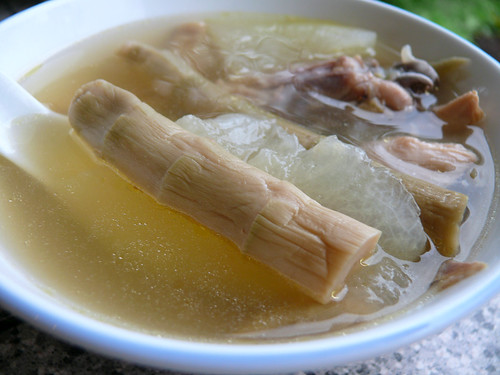
Shanghainese Winter Melon Soup
1 kg pork bones & meat or 1 x 1 kg kampung/village chicken, skinned
500 g piece of fragrant winter melon
100 g salted young bamboo tips, washed and soaked 10 minutes, repeat
a handful of red dates, washed
1 small piece (half a fist) of Chinese ham
Prep: The skin of the winter melon can be left on for extra fragrance but the Shanghainese don't seem to do that. Cut the melon into small chunks of about 4 cm squares. Trim off the hard end of the bamboo stem, if any. If using pork bones & meat, blanch them with boiling water.
1. Put the meat/bones into a pot, add water to cover with a clearance of about 5 cm. Add the ham, bamboo and red dates too and when the water boils, lower the heat until the soup simmers gently, covered.
2. After 1 1/2 hours, bring the soup to a rolling boil, add the winter melon and when the soup boils again, lower the heat and let the soup simmer gently for about 20 minutes, covered. Switch off heat and leave the pot covered.
3. Just before serving, re-heat the soup. Depending on how you like the soup and how much water has evaporated, you can add some water if necessary, but not too much or the taste will be diluted. There's no need to add salt as the bamboo and ham are salty.
Thursday, October 1, 2009
Home-made Hot Sauce
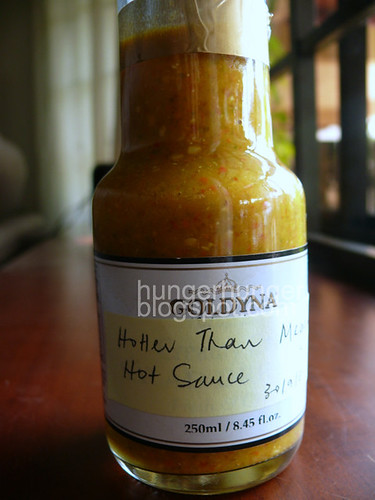
Home-made hot sauce is not red like the commercial ones.
Habaneros and chili padi ('rice chili', because of their tiny size) are the hottest chilies I've ever eaten. Chili size and their level of hotness are inversely related. Big bell peppers taste sweet instead of hot. The smaller the chili, the hotter it is. Shorter people are like that too. The shorter the more fiery. According to a National Geographic program recently, small animals are more colorful to attract mates and ensure survival and propagation of species. It may be the same with shorter people, who are usually more animated, extroverted, wily and capable so it's no wonder the nickname "chili padi" refers to a small person with big fighting spirit.

Birds' eyes chilies, also known as chili padi

Kasturi limes, also known as calamansi
I have a couple of chili padi plants in my back yard. Recently, there are so many chillies even the birds can't finish them so I decided to make chili sauce, Sabah-style, something I've not bothered to do before.
I washed, dried and blended the chillies with plenty of kasturi (calamansi) limes (remove the seeds but keep the skin) and seasoned the sauce with some salt. I didn't want any extra flavor like ginger or garlic in it, so I left it plain. The sauce was more of a paste, so I added some rice vinegar to thin it a bit, but not too much since I like to add some Maggi soy sauce when I use it as a dip. I don't have much experience in pickling anything. I scalded the bottles with boiling water so I hope the chili sauce will keep for some time. That's all my understanding about pickling and preserving; just make sure the bottles are clean and dry.
All that chilies and limes made two small bottles of thick hot sauce. I also suffered from some chili burns on my hands and face but it was worth it. The kasturi limes give a refreshing citrus flavor and the sauce is so hot, it burns my stomach. I find myself hesitating before I eat it. It is almost like a dare. I imagine that's how it feels for guys to get close to Megan Fox. Hot yet scary.
Birds' eyes chilies, also known as chili padi
Kasturi limes, also known as calamansi
I have a couple of chili padi plants in my back yard. Recently, there are so many chillies even the birds can't finish them so I decided to make chili sauce, Sabah-style, something I've not bothered to do before.
I washed, dried and blended the chillies with plenty of kasturi (calamansi) limes (remove the seeds but keep the skin) and seasoned the sauce with some salt. I didn't want any extra flavor like ginger or garlic in it, so I left it plain. The sauce was more of a paste, so I added some rice vinegar to thin it a bit, but not too much since I like to add some Maggi soy sauce when I use it as a dip. I don't have much experience in pickling anything. I scalded the bottles with boiling water so I hope the chili sauce will keep for some time. That's all my understanding about pickling and preserving; just make sure the bottles are clean and dry.
All that chilies and limes made two small bottles of thick hot sauce. I also suffered from some chili burns on my hands and face but it was worth it. The kasturi limes give a refreshing citrus flavor and the sauce is so hot, it burns my stomach. I find myself hesitating before I eat it. It is almost like a dare. I imagine that's how it feels for guys to get close to Megan Fox. Hot yet scary.
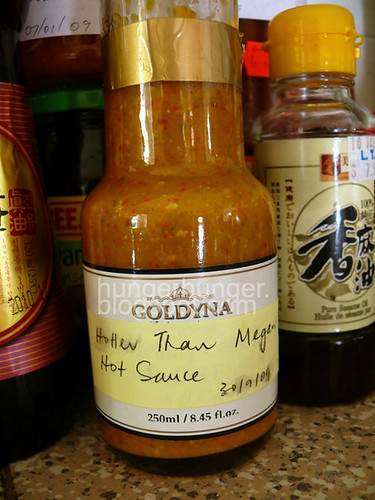
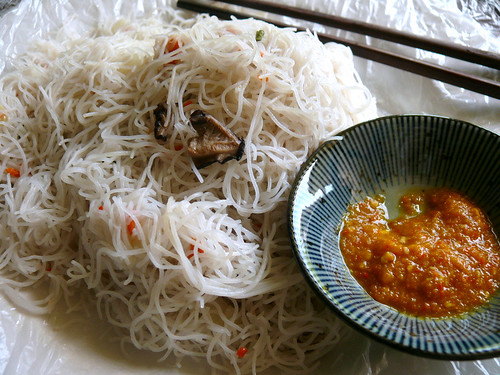
I'll be eating a lot of fried meehoon with my hot sauce, especially the plain white meehoon from the breakfast stall next to Diamond Restaurant.
Wednesday, July 29, 2009
Lotus Root Soup
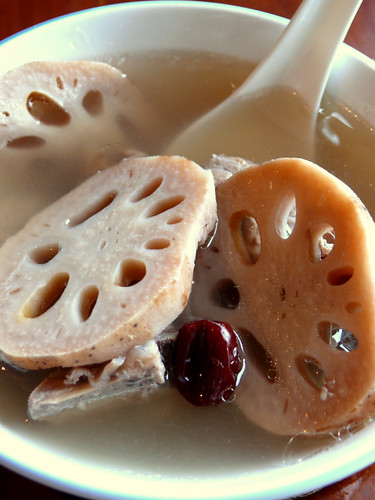
Lotus root soup
Unlike Zurin, I don't have a cat so I may resort to blogging about my toes soon. But I'll try to keep to food as much as I can. This is one of those no-effort-cook week for me, leaving everything to Vero. Just for those of you who never cooked lotus root soup, here's how. I know, I know, just bear with me, not everyone can cook soup. Not even Chinese soups, which are the easiest soups to cook.
When you are feeling a little tired, weak and lifeless, you need a strengthening and nourishing soup like lotus root soup. You can add some peanuts (skin on) to make the soup even richer. All you need are some bones (chicken, pork or beef bones, pork being the traditional choice), dried red dates, dried cuttlefish and lotus root. Make sure the lotus root is fresh and not wrinkled or moldy (told you this post is for those who don't cook--or go marketing). Usually the whole root is put to boil and not sliced but if you are too busy, you can cut it up and chuck all the ingredients to boil in one go. The good thing about cutting the root up is that should it have a bruise or hole on its surface and some mud got in and lined the internal 'tunnels', it can be washed away. Restaurants always cut them up because that way, it is easier to cook and serve. Boiling lotus root whole has its advantage too. You can take the whole root out of the soup after its done and slice them neatly and serve separately, with some soy sauce dip. Just make sure you cut the root into half and flush out the dirt in the holes, if any.
The fun thing about eating boiled lotus root is that when you take a bite and pull the root apart, it 'strings'. And it's tasty and has a unique bite that can be floury and crunchy at the same time. When I'm low on energy and appetite, I like to pour hot lotus root soup over my rice and that's a meal. This soup is especially nice when the weather's cool. Like now, when the clouds are dark and angry and the aroma of the soup fills every room. Lotus root soup on a rainy night like tonight is like a hearty bean soup on a cold wintry night. Super yum and comforting.
This soup tastes even better if you cook it early and let it sit and develop the flavor. Re-heat when ready to eat.

Lotus Root Soup
800g lotus root
700-800 g pork or beef or chicken bones or meat, or combination of
1 small piece (20 g) dried cuttle fish
1 small handful dried red dates
Prep: Scrape the skin off the lotus root, cut off the hard ends and half each root. Wash well to remove any dirt inside the root tunnels. Boil some hot water and pour over the bones or meat until they turn white. Pour away the water. This will remove any unpleasant smell. Soak the red dates, wash & drain. Use a pair of tongs and hold the cuttle fish over a fire until it curls and chars at the edges. Do toast it well or it won't give the soup enough flavor. You can also toast it in the oven. Wash & pick off the burnt parts of the toasted cuttle fish.
1. Put everything in your stock pot, add enough water to cover with about 2 cm of water above the ingredients. If you like the soup to be richer and sweeter, the water should just cover the ingredients. Cover the pot and crank the dial to high. When the soup comes to a boil, reduce heat to medium low and boil for 2 hours. Unless a lot of water has been lost, there's no need to top up the water.
2. Season soup with some white pepper and salt if like. Take the lotus root out and when cool, slice into 1/2 cm slices. You can put the lotus slices back into the soup or serve them separately with a flavored soy sauce like Maggi. Serve the soup hot.
Thursday, July 9, 2009
Black Pepper Sauce

I guess nobody wants their rib eye with sauce made from Gravlox as home-made sauce always tastes so much more authentic and richer. Ideally, you should use the pan in which you fry the steaks to do the sauce so that you get the flavor of the juices from the meat. That is perfect if you are just cooking for one. However, in my experience, cooking more than one steak leaves the pan with lots of burnt bits and the steaks will be cold (warming them in the oven always toughens them) by the time the sauce is ready. So I prefer to do the sauce ahead and warm it up and the sauce doesn't suffer with re-heating. As requested, Joe, this is for you and everyone who likes black pepper sauce:
Black Pepper Sauce (for 4 steaks)
2 T small red onions/shallots, very finely chopped
1/2 T garlic powder (optional & I prefer the powder which is more fragrant)
2-3 T black peppercorns (depending on how intense you want the sauce), cracked coarsely
1 cup dairy cream*
1/2 cup sweet red wine like port, or 1/4 cup brandy
1 cup beef stock or 1 cup water + 2 Oxo cubes, or other beef stock granules (the Korean one is nice)
salt to taste
*if you prefer a less creamy sauce, reduce this to 1/2 cup.

1. If cooking one steak, do not wash the pan or remove the oil after frying your steak. Scrape off the burnt bits but if they aren't burnt, leave them because they add flavor to the sauce. With a low fire, fry the shallots until they are soft and transparent. Add the black pepper, fry, increase the heat and add the wine. If frying more than one steak, put some veg oil or butter into a pan and fry the shallots until soft and add pepper, fry 2 sec, then the wine. Increase the heat to medium.
2. When the wine boils, add the cream, garlic powder if using and the beef stock and let it boil for about 7-10 minutes until medium-thick. Taste and season with salt. If you like the sauce dark like the restaurants', add some browning sauce or dark soy sauce, which is more convenient and cheap and doesn't alter the flavor of the sauce much because you need to add just a little, say, 1/2 teaspoon.
p.s. like i said in my post Gyu The Cow, good steaks should be eaten plain with salt n freshly ground pepper. If you must have a sauce, it's good to have it on the side as a dip and not douse the whole steak with the sauce like I did.
Wednesday, July 1, 2009
Hot & Sour Soup Perfected
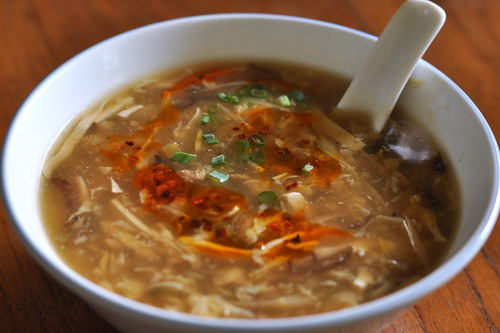
Sichuan hot & sour soup. The tofu should be cut finer--I need more practice.
Another soup, this time one of my favorites.
Remember 6th Aunt in Hong Kong, the one who fell down and broke her ankle on her way out of the dim sum restaurant when we visited last year? She's in town and I managed to get her to cook her hot and sour soup today. 6th Aunt's hot & sour soup was absolutely elegant and tasty, making mine look unrefined and, to tell the truth, it tasted coarse compared to hers.
From coarse to fine is a matter of cutting skills and patience. 6th Aunt cut all her ingredients into tooth-pick julienne strips while I cut mine as thick as chopsticks. On the tongue, the 'chopsticks' are chunky while the 'toothpicks' are delicate. To the eyes too the 'chopsticks' look unappealing while the 'toothpicks' give a foretaste of a smooth-textured soup. I also learnt from 6th Aunt's advice of not using too much ingredients so that the soup won't be like a thick bowl of ingredients in a little bit of starchy soup. That was really how my hot & sour soup tasted, because I tend to have this cooking principle of 'the more ingredients the better', which isn't true for this soup. Adequate amount of ingredients suspended in a silky tasty soup should be the key to a fabulous bowl of hot & sour soup.
Since 6th Aunt cooked without measurement, the recipe below is not rocket-science accurate, and you'll have to adjust the amount of ingredients, seasoning and thickening. Eaten with some guotie and shui jiao, this soup truly tickles the tastebuds with the texture of the many ingredients, the taste ( hot, sour and xien) and flavors (Sichuan peppercorn oil and chili oil). One of my favorite soups, not made this way in any of the restaurants here and surprisingly very well done in Chinese restaurants in the USA, from what I remember.
I have chosen to use canned chicken stock because I think the majority of us don't have home-made chicken stock sitting in the fridge whenever we feel like having quick soups as this. You can brew your chicken stock of course but that's like taking a boat to Singapore (3 days) when you can fly there (2.5 hours).
Reminder: to make a great hot & sour soup, the ingredients must be sliced very thinly and there shouldn't be an overload of ingredients!
Hot & Sour Soup Perfected (serves 6-8)
2 cans chicken stock + 2 cans water (the water is to stretch the soup but you can use stock only)
1/2 small piece of white tofu (about 1/3 cup only), outer 'skin' sliced away n cut into thin strips
3 dried mushrooms, soaked, cut into 3-4 thin layers horizontally n then into very thin strips
1/4 cup cloud's ears (black fungus), soaked, stems discarded and cut into thin strips
1/4 cup golden needles (lily buds), soaked, hard ends snipped off n buds shredded
1/2 cup chicken breast meat, in thin strips, seasoned with sesame oil, salt, pepper n some cornsflour
1/4 cup seasoned ja cai* (a pickled veg), cut into thin strips
1 small egg, beaten lightly
*seasoned ja cai comes in little foil packets
Seasoning:
white pepper (about 1 t)
black vinegar (about 4 T)--I'm told 'jen jiang' vinegar is best
light soy sauce (about 3 T)
sesame oil (about 1 t)
red chili oil to drizzle
Sichuan peppercorn oil to drizzle
To thicken soup:
4-5 T cornflour + same amount of room temp water, mixed
1. Put the chicken stock and water to boil. Add mushrooms and fungus and boil for at least 15 minutes to release the flavor of the mushrooms.
2. Add two tablespoonfuls of water to the meat to help loosen it, add meat into the soup, stirring well to separate, and then add the lily buds. When it comes to a boil, add the tofu.
3. When soup comes to a boil again, add the ja cai. Mix the light soy sauce and the black vinegar in a small bowl (this way you can control the taste better) and add half to the soup, taste, then add more if necessary. Remember that the sourness will be more pronounced when the soup cools. You can add a cup of water if the stock level has gone down.
4. Now add the white pepper (should be quite a lot but if you have sissy eaters, add less pepper and serve extra pepper on the side) and the sesame oil and when the soup is in a rolling boil, add the cornstarch solution slowly, stirring. Check if you like the consistency and add more cornflour solution or water to thicken or thin the soup respectively. Remember that the soup must be heated through to get the cornflour solution to thicken it. Switch off the heat and pour the egg in in a slow trail, stirring the soup in large circles with your other hand holding a pair of chopsticks or fork to make 'egg flower'.
5. Taste and season if necessary, then ladle into individual bowls and drizzle with chili oil and Sichuan peppercorn oil. Serve hot.
Remember 6th Aunt in Hong Kong, the one who fell down and broke her ankle on her way out of the dim sum restaurant when we visited last year? She's in town and I managed to get her to cook her hot and sour soup today. 6th Aunt's hot & sour soup was absolutely elegant and tasty, making mine look unrefined and, to tell the truth, it tasted coarse compared to hers.
From coarse to fine is a matter of cutting skills and patience. 6th Aunt cut all her ingredients into tooth-pick julienne strips while I cut mine as thick as chopsticks. On the tongue, the 'chopsticks' are chunky while the 'toothpicks' are delicate. To the eyes too the 'chopsticks' look unappealing while the 'toothpicks' give a foretaste of a smooth-textured soup. I also learnt from 6th Aunt's advice of not using too much ingredients so that the soup won't be like a thick bowl of ingredients in a little bit of starchy soup. That was really how my hot & sour soup tasted, because I tend to have this cooking principle of 'the more ingredients the better', which isn't true for this soup. Adequate amount of ingredients suspended in a silky tasty soup should be the key to a fabulous bowl of hot & sour soup.
Since 6th Aunt cooked without measurement, the recipe below is not rocket-science accurate, and you'll have to adjust the amount of ingredients, seasoning and thickening. Eaten with some guotie and shui jiao, this soup truly tickles the tastebuds with the texture of the many ingredients, the taste ( hot, sour and xien) and flavors (Sichuan peppercorn oil and chili oil). One of my favorite soups, not made this way in any of the restaurants here and surprisingly very well done in Chinese restaurants in the USA, from what I remember.
I have chosen to use canned chicken stock because I think the majority of us don't have home-made chicken stock sitting in the fridge whenever we feel like having quick soups as this. You can brew your chicken stock of course but that's like taking a boat to Singapore (3 days) when you can fly there (2.5 hours).
Reminder: to make a great hot & sour soup, the ingredients must be sliced very thinly and there shouldn't be an overload of ingredients!
Hot & Sour Soup Perfected (serves 6-8)
2 cans chicken stock + 2 cans water (the water is to stretch the soup but you can use stock only)
1/2 small piece of white tofu (about 1/3 cup only), outer 'skin' sliced away n cut into thin strips
3 dried mushrooms, soaked, cut into 3-4 thin layers horizontally n then into very thin strips
1/4 cup cloud's ears (black fungus), soaked, stems discarded and cut into thin strips
1/4 cup golden needles (lily buds), soaked, hard ends snipped off n buds shredded
1/2 cup chicken breast meat, in thin strips, seasoned with sesame oil, salt, pepper n some cornsflour
1/4 cup seasoned ja cai* (a pickled veg), cut into thin strips
1 small egg, beaten lightly
*seasoned ja cai comes in little foil packets
Seasoning:
white pepper (about 1 t)
black vinegar (about 4 T)--I'm told 'jen jiang' vinegar is best
light soy sauce (about 3 T)
sesame oil (about 1 t)
red chili oil to drizzle
Sichuan peppercorn oil to drizzle
To thicken soup:
4-5 T cornflour + same amount of room temp water, mixed
1. Put the chicken stock and water to boil. Add mushrooms and fungus and boil for at least 15 minutes to release the flavor of the mushrooms.
2. Add two tablespoonfuls of water to the meat to help loosen it, add meat into the soup, stirring well to separate, and then add the lily buds. When it comes to a boil, add the tofu.
3. When soup comes to a boil again, add the ja cai. Mix the light soy sauce and the black vinegar in a small bowl (this way you can control the taste better) and add half to the soup, taste, then add more if necessary. Remember that the sourness will be more pronounced when the soup cools. You can add a cup of water if the stock level has gone down.
4. Now add the white pepper (should be quite a lot but if you have sissy eaters, add less pepper and serve extra pepper on the side) and the sesame oil and when the soup is in a rolling boil, add the cornstarch solution slowly, stirring. Check if you like the consistency and add more cornflour solution or water to thicken or thin the soup respectively. Remember that the soup must be heated through to get the cornflour solution to thicken it. Switch off the heat and pour the egg in in a slow trail, stirring the soup in large circles with your other hand holding a pair of chopsticks or fork to make 'egg flower'.
5. Taste and season if necessary, then ladle into individual bowls and drizzle with chili oil and Sichuan peppercorn oil. Serve hot.
Sunday, June 28, 2009
Dried Bak Choy Soup

Bak choy soup
The last batch of dried bak choy I bought from a Chinese herbal shop was so tough we couldn't chew on the veg even after 3 hours of boiling, so I decided to dry my own bak choy. I was surprised to find that the bak choy took about 10 days to dry completely. Another surprise was the that the bak choy shrank by as much as 10 times in volume. The color of the leaves were light brown, unlike the commercial ones which are almost black in color. I think the darker the color, the older the veg and that's why 3 hours of boiling didn't soften it.
Ming is a soup king. He is happy as long as he gets soup, and it doesn't matter if it's a quick soup to help wash his food down and rehydrate his system or a soup that's simmered for 3 hours to nourish his body, as long as it's a Chinese soup. Wey, on the other hand, is the only one in the family who doesn't drink Chinese soups so I have to stock up on Campbell's soups for him. Ming is very lucky that his "Australian mom" takes the trouble to cook Chinese soups just for him.
Friends who have migrated to western countries always tell me they can't make certain soup s because they can't get village chickens and regular chicken bones have an awful chicken flavor. Pork bones are the worst, smelling like what my mom said is pig pee which of course is not true but it comes close, I imagine. I think the piggy stink is because of the breed (and some say gender) and westerners expect their pork piggy so they don't mind it whereas in serious pork-eating countries (like China and anywhere you find Chinese), they rear pigs that don't have that piggy stink. If you can't get good pork or pork bones, use stewing beef or bones although traditionally this soup is made with pork. Add a small slice of ginger if using beef.
I've recently switched from using pork bones for my soup base to a cut of pork called yau moi dai in Hakka, meaning 'waist belt'. It is a piece of long lean meat covered with a thick membrane-like skin, and I'm told it is attached to the top of the tenderloin. Yau moi dai should not be cut it into small pieces; just boil it whole and cut after it's done. It will taste sweeter. The soup made with yau moi dai is just as sweet as pork bones soup with the advantage of being not oily. I've noticed that some people, especially Malaysians, add dried squid to all their simmered soups. That is so wrong. Not all traditional Chinese soups call for dried squid. In fact, sometimes the flavor of the dried squid overwhelms certain soups. Dried bak choy soup and watercress soup are two soups I can think of that don't need dried squid or dried oysters.
Dried bak choy soup is one of those old traditional favorites, cooked by moms when their families need something to cool their bodies. Many Chinese believe in heaty and cooling food--the Ying and Yang thing. Foods are heaty or cooling depending on the way they are cooked and on their intrinsic properties. Durians for example are very heaty fruits while mangosteens are cooling, and so it's best to eat both to balance the yingyang scale. Fried, roasted and bbqed food are heaty while boiled and steamed food are not. Some people are very sensitive to the heaty-cooling thing but I find it telling that our family doesn't bother much with it and so we don't suffer from heatiness or exteme coolness. It's like ghosts; the more you believe in them the more you'll see them. We have a friend who sees them everywhere and I can tell you it's very unnerving when he starts telling you who or what is in the room.
The bak choy shrank so much that I had to add fresh bak choy to the soup, but that combination makes a very refreshing soup. You can use wholly dried bak choy or add some fresh bak choy like I did. I will continue to dry my own bak choy from now on because other than the better texture and tastier soup it makes, and the fact that my choy is organic, home-dried bak choy has none of the slight sourness that commercial dried bak choy sometimes give. There's so much fiber in this soup, you'll feel very detoxed the next day.
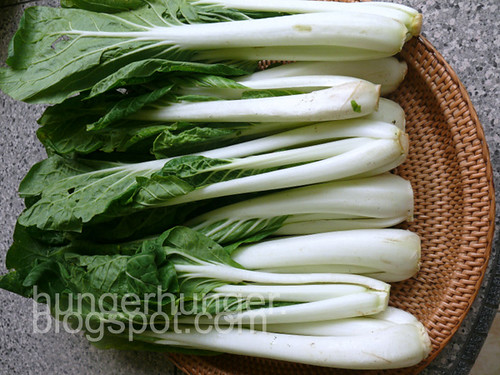
Fresh bak choy. To make your own, get the long-stemmed bak choy, wash well and hang them on a line to dry. When wilted, you can put on a metal tray or bamboo tray to dry. Dry it in hot sun until it is like straw.
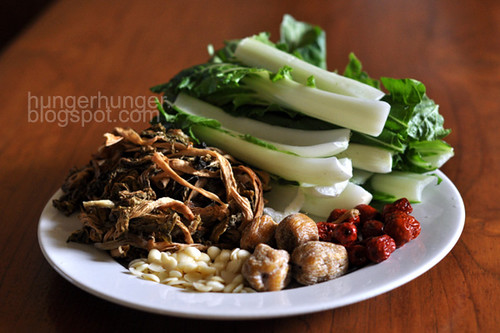
The ingredients for bak choy soup--I used 3 x as much fresh choy than shown in the photo. This is the amount of dried bak choy I got from the fresh choy in the previous photo.
Dried Bak Choy Soup (for 8-10 servings)
700-800 kg pork meat or 1 kg pork bones, or mixture of
a handful of dried bak choy (say 1 cup, compacted), soaked, washed n cut into 6 cm lengths
300-400g fresh bak choy, cut into 6-8 cm lengths
1 small handful red dates, washed
4-5 honey dates, preferably the sugar-free ones (if unavailable, substitute with ordinary dates)
2 T Chinese apricot kernels (for soups), washed
salt to taste, if using
1. Clean the pork meat or bones, then blanch them with boiling water and drain.
2. Put the meat/bones into a large pot and add enough water to give about 8 cm clearance from the ingredients to the water level. Add the red dates, honey dates, almonds and dried bak choy and let soup simmer 1 hour.
3. Add the fresh bak choy, season with salt lightly and simmer another hour (I don't believe in simmering for longer than 2-2 1/2 hours, unlike my MIL who simmers her soups for 3-4 hours). Do not add more water unless the water level is very low. Serve hot.
The last batch of dried bak choy I bought from a Chinese herbal shop was so tough we couldn't chew on the veg even after 3 hours of boiling, so I decided to dry my own bak choy. I was surprised to find that the bak choy took about 10 days to dry completely. Another surprise was the that the bak choy shrank by as much as 10 times in volume. The color of the leaves were light brown, unlike the commercial ones which are almost black in color. I think the darker the color, the older the veg and that's why 3 hours of boiling didn't soften it.
Ming is a soup king. He is happy as long as he gets soup, and it doesn't matter if it's a quick soup to help wash his food down and rehydrate his system or a soup that's simmered for 3 hours to nourish his body, as long as it's a Chinese soup. Wey, on the other hand, is the only one in the family who doesn't drink Chinese soups so I have to stock up on Campbell's soups for him. Ming is very lucky that his "Australian mom" takes the trouble to cook Chinese soups just for him.
Friends who have migrated to western countries always tell me they can't make certain soup s because they can't get village chickens and regular chicken bones have an awful chicken flavor. Pork bones are the worst, smelling like what my mom said is pig pee which of course is not true but it comes close, I imagine. I think the piggy stink is because of the breed (and some say gender) and westerners expect their pork piggy so they don't mind it whereas in serious pork-eating countries (like China and anywhere you find Chinese), they rear pigs that don't have that piggy stink. If you can't get good pork or pork bones, use stewing beef or bones although traditionally this soup is made with pork. Add a small slice of ginger if using beef.
I've recently switched from using pork bones for my soup base to a cut of pork called yau moi dai in Hakka, meaning 'waist belt'. It is a piece of long lean meat covered with a thick membrane-like skin, and I'm told it is attached to the top of the tenderloin. Yau moi dai should not be cut it into small pieces; just boil it whole and cut after it's done. It will taste sweeter. The soup made with yau moi dai is just as sweet as pork bones soup with the advantage of being not oily. I've noticed that some people, especially Malaysians, add dried squid to all their simmered soups. That is so wrong. Not all traditional Chinese soups call for dried squid. In fact, sometimes the flavor of the dried squid overwhelms certain soups. Dried bak choy soup and watercress soup are two soups I can think of that don't need dried squid or dried oysters.
Dried bak choy soup is one of those old traditional favorites, cooked by moms when their families need something to cool their bodies. Many Chinese believe in heaty and cooling food--the Ying and Yang thing. Foods are heaty or cooling depending on the way they are cooked and on their intrinsic properties. Durians for example are very heaty fruits while mangosteens are cooling, and so it's best to eat both to balance the yingyang scale. Fried, roasted and bbqed food are heaty while boiled and steamed food are not. Some people are very sensitive to the heaty-cooling thing but I find it telling that our family doesn't bother much with it and so we don't suffer from heatiness or exteme coolness. It's like ghosts; the more you believe in them the more you'll see them. We have a friend who sees them everywhere and I can tell you it's very unnerving when he starts telling you who or what is in the room.
The bak choy shrank so much that I had to add fresh bak choy to the soup, but that combination makes a very refreshing soup. You can use wholly dried bak choy or add some fresh bak choy like I did. I will continue to dry my own bak choy from now on because other than the better texture and tastier soup it makes, and the fact that my choy is organic, home-dried bak choy has none of the slight sourness that commercial dried bak choy sometimes give. There's so much fiber in this soup, you'll feel very detoxed the next day.
Fresh bak choy. To make your own, get the long-stemmed bak choy, wash well and hang them on a line to dry. When wilted, you can put on a metal tray or bamboo tray to dry. Dry it in hot sun until it is like straw.
The ingredients for bak choy soup--I used 3 x as much fresh choy than shown in the photo. This is the amount of dried bak choy I got from the fresh choy in the previous photo.
Dried Bak Choy Soup (for 8-10 servings)
700-800 kg pork meat or 1 kg pork bones, or mixture of
a handful of dried bak choy (say 1 cup, compacted), soaked, washed n cut into 6 cm lengths
300-400g fresh bak choy, cut into 6-8 cm lengths
1 small handful red dates, washed
4-5 honey dates, preferably the sugar-free ones (if unavailable, substitute with ordinary dates)
2 T Chinese apricot kernels (for soups), washed
salt to taste, if using
1. Clean the pork meat or bones, then blanch them with boiling water and drain.
2. Put the meat/bones into a large pot and add enough water to give about 8 cm clearance from the ingredients to the water level. Add the red dates, honey dates, almonds and dried bak choy and let soup simmer 1 hour.
3. Add the fresh bak choy, season with salt lightly and simmer another hour (I don't believe in simmering for longer than 2-2 1/2 hours, unlike my MIL who simmers her soups for 3-4 hours). Do not add more water unless the water level is very low. Serve hot.
Wednesday, January 14, 2009
Chinese White Radish Beef Ribs Soup

Cantonese are big on soups and their soups are the easiest things to cook. You only need very few ingredients but lots of time because traditional Cantonese soup is boiled for hours. I am not a patient person, and I don't like to boil my soups for too long. The most I'll boil my kampung (village) chicken is 1 1/2 hours and for my pork bones soups, lightly longer, about 2 hours. Beef bones soups take the longest, nearly 4 hours, and I do cheat with a pressure cooker.
For rainy days such as what we are getting now, Chinese white radish (daikon) with beef ribs soup is bound to please the family, especially the guys. I think it's because the beefy goodness is more hearty, more macho, as versus sissy soups like corn soup. This soup is flavorful and nutritious but a little heavy on the oil so I usually boil a big pot and scoop off the top half into a big bowl and chill it so that the hardened layer of oil on top can be easily peeled off.
I have seen some recipes for the same soup with a hotch potch of ingredients including dried squid and dried oysters and I can tell you something's gone wrong there. You never put these dried seafood in white radish beef ribs soup, at least that's not the authentic Cantonese way. It's fine to use dried seafood with pork bones for winter melon soup but not beef and white radish. My dad, if I don't remember wrong, liked to add a piece of dried tangerine peel to his white radish beef ribs soup. The dried peel gives off a citrussy flavor and goes very well to blend the beefy stock with the more subtle-flavored white radish. However, sometimes the peel may overpower the beef flavor so I usually omit it or use a very small piece.
As with most long-stewing dishes, the soup's flavor develops and deepens the next day so most times I make sure there's enough leftover for a light lunch the next day. When Hub comes home for lunch, and it's rainy out, this tasty soup with plain rice though simple, is warming and satisfying, and life feels good. Just because of a soup.
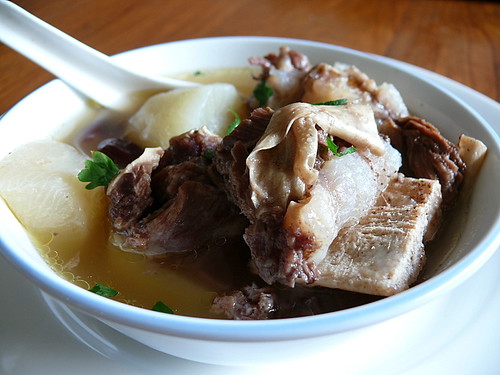
Chinese White Radish Beef Ribs Soup
1 very large white radish/daikon
1.5 kg beef ribs, chopped into 4 to 5 cm lengths
a handful of good red dates (with seeds intact), soaked n washed
1 4X4 cm piece of dried tangerine or mandarin peel (optional), washed
1 slice of fresh ginger, about 1/2 cm thick by 4 cm long
water
1. Peel and cut the white radish into chunks of about 4 cm long, turning the radish as you cut so that the chunks are diagonally cut.
2. Trim the ribs well of any fat. Blanch the ribs with plenty of boiling water for a minute to remove any dirt and smell. Drain.
3. Boil a large pot (you can use a pressure cooker too) of water enough to cover the ribs 2 times over and add the ribs, mandarin peel, ginger and red dates. When the water boils again, lower the heat to medium and boil for about 2 hours or until ribs are half-tender. Add some water if it has evaporated, but not too much or the taste will be too diluted. If the lid of the pot is tight and the fire not too high, you may not need to add water at all. Some water loss is expected from all the boiling.
4. Add the white radish and boil again in medium-low heat for 1 1/2 hours or more, until the beef is tender but not falling off the bones. Season with salt and pepper.
For rainy days such as what we are getting now, Chinese white radish (daikon) with beef ribs soup is bound to please the family, especially the guys. I think it's because the beefy goodness is more hearty, more macho, as versus sissy soups like corn soup. This soup is flavorful and nutritious but a little heavy on the oil so I usually boil a big pot and scoop off the top half into a big bowl and chill it so that the hardened layer of oil on top can be easily peeled off.
I have seen some recipes for the same soup with a hotch potch of ingredients including dried squid and dried oysters and I can tell you something's gone wrong there. You never put these dried seafood in white radish beef ribs soup, at least that's not the authentic Cantonese way. It's fine to use dried seafood with pork bones for winter melon soup but not beef and white radish. My dad, if I don't remember wrong, liked to add a piece of dried tangerine peel to his white radish beef ribs soup. The dried peel gives off a citrussy flavor and goes very well to blend the beefy stock with the more subtle-flavored white radish. However, sometimes the peel may overpower the beef flavor so I usually omit it or use a very small piece.
As with most long-stewing dishes, the soup's flavor develops and deepens the next day so most times I make sure there's enough leftover for a light lunch the next day. When Hub comes home for lunch, and it's rainy out, this tasty soup with plain rice though simple, is warming and satisfying, and life feels good. Just because of a soup.
Chinese White Radish Beef Ribs Soup
1 very large white radish/daikon
1.5 kg beef ribs, chopped into 4 to 5 cm lengths
a handful of good red dates (with seeds intact), soaked n washed
1 4X4 cm piece of dried tangerine or mandarin peel (optional), washed
1 slice of fresh ginger, about 1/2 cm thick by 4 cm long
water
1. Peel and cut the white radish into chunks of about 4 cm long, turning the radish as you cut so that the chunks are diagonally cut.
2. Trim the ribs well of any fat. Blanch the ribs with plenty of boiling water for a minute to remove any dirt and smell. Drain.
3. Boil a large pot (you can use a pressure cooker too) of water enough to cover the ribs 2 times over and add the ribs, mandarin peel, ginger and red dates. When the water boils again, lower the heat to medium and boil for about 2 hours or until ribs are half-tender. Add some water if it has evaporated, but not too much or the taste will be too diluted. If the lid of the pot is tight and the fire not too high, you may not need to add water at all. Some water loss is expected from all the boiling.
4. Add the white radish and boil again in medium-low heat for 1 1/2 hours or more, until the beef is tender but not falling off the bones. Season with salt and pepper.
Tuesday, November 4, 2008
Ma's Lu Song Tang
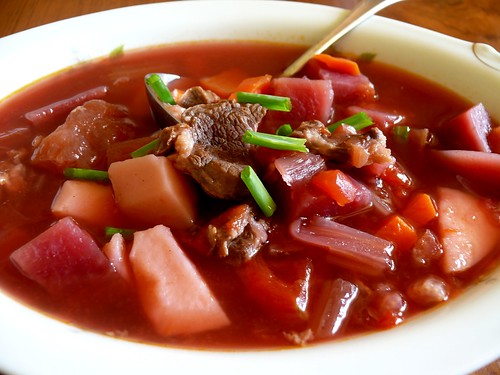
Chinese Russian soup, luo song tang
My MIL is one of the top 3 cooks I know. Her cooking motto (unofficially) is 'taste first, everything else second'. This means she'll fry and then braise when she does a 'red-cook' meat, use the best ingredients and not scrimp on oil. She also doesn't cut corners and washes her wok clean each time she fries some thing so that she never gets burnt bits in her food. Those who know Chinese stir-fry will know what I mean: if you have, say, 3 ingredients in a stir fry, you should fry each separately, washing the wok clean after each frying, because not all ingredients cook in the same time. After each ingredient is cooked to the right level of crispness/doneness, you then fry them altogether to blend the tastes. I fry each ingredient one after the other without washing in between frying (even though Vero stands by to wash) so my dishes never turn out as perfect as MIL's.
One of the soups MIL cooks often is what she calls "luo song tang" (pronounced "loo soong tongue") or Russian soup. I think luo song tang is the Chinese version of the famous Russian veg soup, borscht. There are many versions of borscht in Eastern Europe countries such as the Ukraine, Poland etc and the main ingredients used are beets and cabbage. The Chinese version is simpler, as all Chinese soup are light and watery instead of thick and creamy because Chinese soup is drunk to clear the palate, not fill the stomach.
We love it when we go to MIL's house for Saturday dinners and a big pot of luo song tang is bubbling and giving the house a warm, comforting aroma. Through the years, I have taught MIL to westernize her soup by flavoring it with bay leaves and a can of tomatoes puree, which thickens the soup and adds a stimulating tanginess.
The last few weeks have been wet and rainy, perfect weather for luo song tang. Another reason I cooked this is to post the recipe for Ming, who's homesick for home-cooked soups. I added a large beet to redden the soup, but MIL doesn't do that.
Ma's Luo Song Tang
1.5 kg beef shin or any stewing beef, cut into small 2 cm cubes
1 medium can tomato puree*
1/2 kg tomatoes, 2 cm cubes*
1-2 large carrot, 2 cm cubes
4 sticks celery, 2 cm lengths
2 large potatoes, 2 cm cubes
1 medium sized beet (optional), 2 cm cubes
1 large onion, 2 cm cubes
2 large bay leaves
1/4 t freshly ground black pepper
salt to taste
*MIL blanches the fresh tomatoes, then remove their skin and seeds but I don't bother. If you don't want to add tomato puree, increase the fresh tomatoes to 1 kg.
1. Boil about 6 liters of water, add the beef, onions, tomatoes and bay leaf and boil until beef is half-done. If you don't like the beef too soft, go to step 2 after 45 minutes and when beef is still hard.
2. Add the celery and beets to the soup and let simmer for about an hour. Then add the carrots, potatoes and tomato puree and the seasonings and boil until potatoes are slightly soft. If the water level is too low, add 1 or 2 cups of water if like, let soup come to a boil again and switch off the fire and leave the veg to rest and imbibe the soup.
3. Just before serving, heat soup up.
My MIL is one of the top 3 cooks I know. Her cooking motto (unofficially) is 'taste first, everything else second'. This means she'll fry and then braise when she does a 'red-cook' meat, use the best ingredients and not scrimp on oil. She also doesn't cut corners and washes her wok clean each time she fries some thing so that she never gets burnt bits in her food. Those who know Chinese stir-fry will know what I mean: if you have, say, 3 ingredients in a stir fry, you should fry each separately, washing the wok clean after each frying, because not all ingredients cook in the same time. After each ingredient is cooked to the right level of crispness/doneness, you then fry them altogether to blend the tastes. I fry each ingredient one after the other without washing in between frying (even though Vero stands by to wash) so my dishes never turn out as perfect as MIL's.
One of the soups MIL cooks often is what she calls "luo song tang" (pronounced "loo soong tongue") or Russian soup. I think luo song tang is the Chinese version of the famous Russian veg soup, borscht. There are many versions of borscht in Eastern Europe countries such as the Ukraine, Poland etc and the main ingredients used are beets and cabbage. The Chinese version is simpler, as all Chinese soup are light and watery instead of thick and creamy because Chinese soup is drunk to clear the palate, not fill the stomach.
We love it when we go to MIL's house for Saturday dinners and a big pot of luo song tang is bubbling and giving the house a warm, comforting aroma. Through the years, I have taught MIL to westernize her soup by flavoring it with bay leaves and a can of tomatoes puree, which thickens the soup and adds a stimulating tanginess.
The last few weeks have been wet and rainy, perfect weather for luo song tang. Another reason I cooked this is to post the recipe for Ming, who's homesick for home-cooked soups. I added a large beet to redden the soup, but MIL doesn't do that.
Ma's Luo Song Tang
1.5 kg beef shin or any stewing beef, cut into small 2 cm cubes
1 medium can tomato puree*
1/2 kg tomatoes, 2 cm cubes*
1-2 large carrot, 2 cm cubes
4 sticks celery, 2 cm lengths
2 large potatoes, 2 cm cubes
1 medium sized beet (optional), 2 cm cubes
1 large onion, 2 cm cubes
2 large bay leaves
1/4 t freshly ground black pepper
salt to taste
*MIL blanches the fresh tomatoes, then remove their skin and seeds but I don't bother. If you don't want to add tomato puree, increase the fresh tomatoes to 1 kg.
1. Boil about 6 liters of water, add the beef, onions, tomatoes and bay leaf and boil until beef is half-done. If you don't like the beef too soft, go to step 2 after 45 minutes and when beef is still hard.
2. Add the celery and beets to the soup and let simmer for about an hour. Then add the carrots, potatoes and tomato puree and the seasonings and boil until potatoes are slightly soft. If the water level is too low, add 1 or 2 cups of water if like, let soup come to a boil again and switch off the fire and leave the veg to rest and imbibe the soup.
3. Just before serving, heat soup up.
Wednesday, May 21, 2008
Shanghainese Big Sprouts N Tomatoes Soup
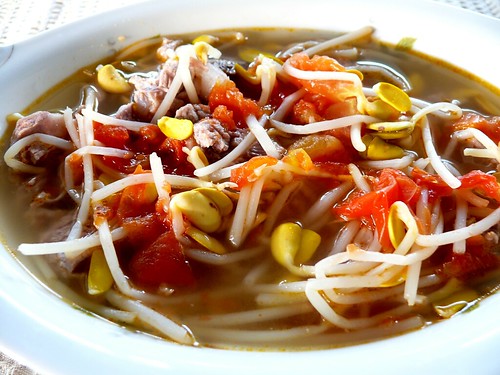
This blog has been rather quiet recently, yes? Let's see what excuses I shall give. How about my replacement maid has gone to Tawau with her regular employer and I am too hassled with the housework to cook anything special? Here's another: Big son Ming's A-Level exams just started Monday and I'm too busy catering to him? The true reason? I am just to lazy to wash up without help. (Btw, I hate ironing! I have 4 days of clothes waiting to be ironed, and I am nearly reaching out for Prozac. Why doesn't someone come up with an ironing machine??) I will be posting simple everyday home dishes that require minimum preparation so bear with me until Vero comes back 'habis bulan'.
Ming is a soup person. If he comes to dinner and there's no soup, he gets very disappointed and it is terrible for me as a mother who wants to please and feed her brood especially when they are having their exams. He suffers from a dry throat, he tells me. So his potential wife just needs to cook soup soup soup. It doesn't have to be a fancy soup. He is happy with plain miso and seaweed soup. Today he wants his Shanghainese grandma's tomato and big bean sprouts soup with pork bones, boiled for hours until the meat falls off. Ha, what I really did was use a pressure cooker, that wonder pot. This is a tangy soup that is very refreshing especially if you have over-eaten recently. Try it.
Big Bean Sprouts N Tomatoes Soup
1 kg pork bones, cut into 5 cm pieces
400g ripe tomatoes, deseeded if like
3 bunches (about 400g) big bean sprouts*
1 piece thumb-sized fresh ginger, smashed
salt to taste
* These are soy bean sprouts, not the usual beans sprouts which are sprouted from mung beans. They are usually tied in bunches and soaked in water.
1. Blanch the pork bones with boiling water to remove smell and dirt; drain away the water. Cut tomatoes into large wedges. Tail and wash the sprouts.
2. Boil about 4 liters of water in a heavy pot and put all the ingredients in (except salt) and simmer for 1 1/2 to 2 hours. If using a pressure cooker, this only takes 30 to 40 minutes from the time the pot hisses. Season lightly with salt.
Wednesday, March 12, 2008
Zuppa De Mare
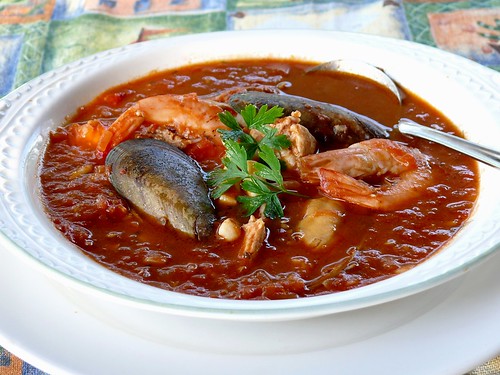
I haven't diluted the soup here yet, for photographic effect (another way of saying soup was too thick).
My son Ming's favorite item at Little Italy is zuppa de mare( Italian seafood soup). At RM22/US$7 per bowl (before tax too), this is one expensive soup especially when the restaurant is just a family restaurant, not one of those 4 or 5-star places. So to the kitchen I go. The first try was not bad, but Ming thought it wasn't sour enough so on the second try I used fresh tomatoes rather than canned puree. I'm not sure how it compares with Little It's but Ming seemed to like it; he refilled twice. (I didn't ask. We are taking a breather from each other. Again.)
The seafood used must be very fresh and not frozen or the soup'll have that refrigerated food taste. Yes, I learnt my mistake.
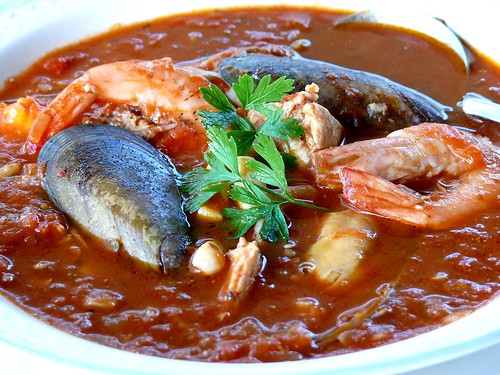
Zuppa De Mare(6 big helpings)
600g very ripe tomatoes
2 cans (4 cups) chicken or fish stock
2 cups water
10 medium-sized prawns, shells on but dirt veins removed
8 cooked mussels and/or 1/2 cup cooked or uncooked clams
1/2 cup fresh squid rings and/or fresh scallops
1/2 cup firm boneless white fish, in 2 cm cubes
1 T finely chopped garlic
1 cup finely chopped onions
2 T tomato paste
4 T olive oil
2 dried bay leaves
1 t dried oregano
1 t salt + 1/4 t black pepper
parsley for garnish
1. Boil a small pot of water, switch off, put in the tomatoes and cover. After 1 minute, drain and peel the skins off tomatoes. Return tomatoes to pot. If you are using plum tomatoes, you don't have to remove the seeds because there usually aren't many seeds. With round tomatoes, remove seeds if you mind them. I don't. Use a potato masher and mash the tomatoes into a pulp.
2. Heat up a pot and add the olive oil. Fry the garlic and onions until soft, then add the water, stock, bay leaves, oregano and mashed tomatoes. Let soup simmer for about 20 minutes.
3. Whisk in the tomato paste, add the salt and pepper and now add the seafood except for the fish. When soup boils, add the fish. If you like the soup thinner, add some water. Season to taste. Garnish with small sprigs of parsley.
Wednesday, February 13, 2008
Khong Aunty's Prosperity Soup
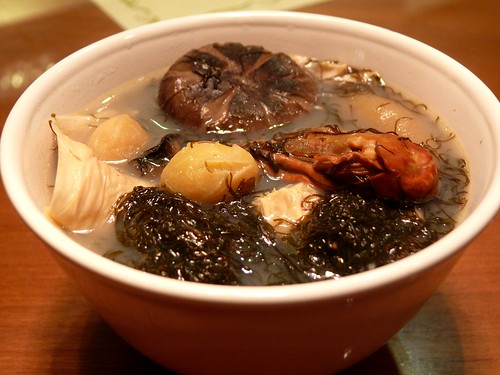
Looks like I put a handful of hair into the soup??
My friend Khong's mom used to cook the family a special fatt choy soup for CNY. Upto that point (more than 10 years ago), I had never heard of fatt choy soup because we ate fatt choy as a stew instead. Since then I have cooked fatt choy soup only a couple of times on CNY so it makes it all the more special.
I was told that black moss (called fatt choy in Cantonese, which also sounds like 'to prosper') has been found to have some toxins that can attack the nervous system (is that why my motor skills are so bad today? I kept typing 'p' instead of 'o') so it is a good thing we only eat it once in a few years. Maybe it is wiser not to add the moss to the soup because it has no particular flavor at all. The other thing about black moss is that it is found in the wilds of Mongolia, making it very rare and expensive. Which means the black moss we eat may not be the real thing, because at RM300 per kg, it really is not expensive as it is light as air.
Ming, a soup lover, took a sip of this soup last night and said "Perfect!" I was surprised that even Wey drank half a bowl. Some may not like it because the dried oysters will give the soup a fishy smoky flavor and the addition of so many ingredients makes it a delicious but rich and heavy soup. I could only manage one bowl.
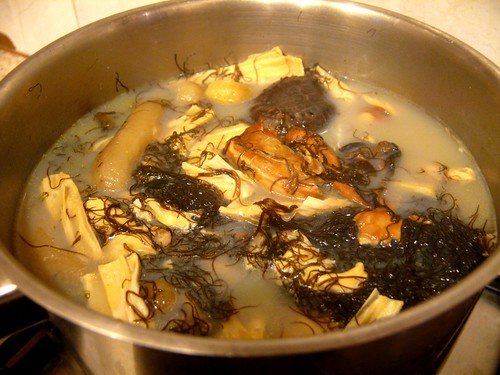
Khong Aunty's Prosperity Soup
1 kg pork bones, washed & fat trimmed off
1 handful black moss, soaked & washed well
6 to 8 large dried oysters, soaked
10 dried chinese mushrooms, soaked
1/2 cup peeled gingko nuts
1 cup sliced sea cucumber (optional)
1/2 pkt dried beancurd sticks, soaked till soft, in 6 cm lengths
1 cup peeled water chestnuts
10 red dates, soaked & washed
2 thin slices ginger
salt and white pepper to taste
1. Blanch the pork bones with plenty of boiling water to get rid of any dirt and smell. Put bones into a large pot with the ginger, red dates, mushrooms and plenty of water and simmer for 1 to 1 1/2 hours or until the meat falls off the bones.
2. Add the gingko nuts, water chestnuts and oysters and simmer another 30 minutes. Add the sea cucumber. The soup will turn cloudy because of the dried oysters. If you like to, remove the bones and meat because they are tasteless by now.
3. When the sea cucumber is tender, you can add the beancurd sticks, salt and white pepper to taste. Lastly add the black moss (this softens and disintegrates easily) and switch off the heat.
Subscribe to:
Posts (Atom)
