Wednesday, April 29, 2009

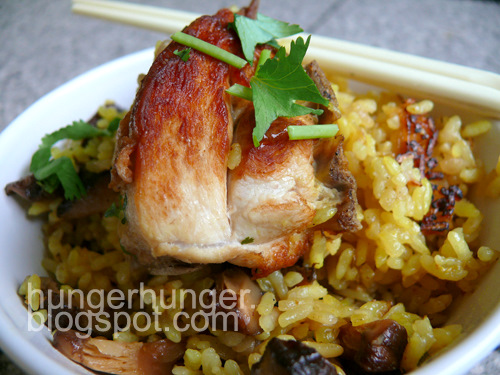
Coriander Chicken Rice

P1320094-1

One of my fav quick meals is the Shanghainese cai fan, a pot of rice cooked with loads of veg. All you need to go with cai fun is a meat dish and a light soup, or you can even add some fried meat such as chicken or pork or Chinese sausages into the rice while it cooks and that's a meal. Another quick meal I like to do is the men tiao. This is home-made noodles made instantly, and cooks faster than dried mi fun. I like my men tiao cooked in chicken stock, with a couple of slices of fresh fish and some iceberg lettuce. Another version I like to do is men tiao with pork slices, pork balls, liver and sayur manis.

One-pot rice casseroles are the easiest thing to cook if you are out of ideas/lazy/on a budget/all three. My fav rice casserole is of course dried Chinese mushrooms with chicken, flavored with plenty of soy sauce and garlic. Last week I cooked a coriander chicken rice casserole (a recipe from The Australian Women's Weekly) which was okay, meaning it won't give you lots of compliments. I'd make some changes to the recipe if I cook this again: I'd chop the chicken into smaller pieces and cook them in the stock to make the chicken moister and more tender. I'd also marinade the chicken and mushrooms together so they are better-flavored.
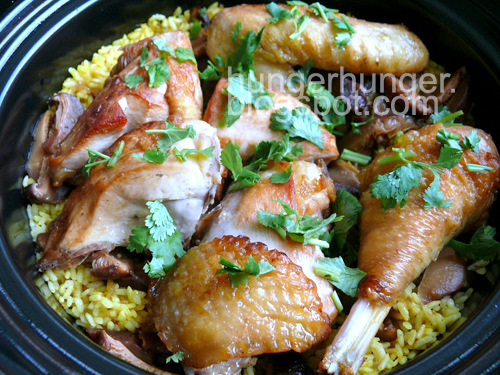
P1320087 copy-1
Coriander Chicken Rice Casserole
4 large chicken thighs or 1/2 chicken, chopped into large pieces, with or w/o skin
2 cups long grain rice, washed
8-10 dried Chinese mushrooms, soaked & sliced
1 brown onion, chopped
1 can chicken stock or enough home-made chicken stock
1 T coriander seeds (ketumbar), toasted lightly & pounded
3 T fish sauce
4-5 cloves garlic, minced
1 t ground tumeric
oil, salt, white pepper

1. Marinade the chicken and mushrooms with the fish sauce, 1/4 t salt and some white pepper for an hour.

2. You can choose not to fry the chicken and mushrooms. Frying them will give better color and flavor. Just put about 1 T oil into your wok or fry pan and fry the chicken and mushrooms. When browned, add the marinade sauce and about 2 T water and cover, cook for 2-3 minutes.

3. Heat 1 T oil in a claypot or casserole pot, add the onions, garlic, coriander seeds and fry in low-medium fire for a minute. Add the rice and tumeric powder and stir well until fragrant, another 2 minutes or so. Do not burn the rice. If you are using an electric rice cooker, you now tranfer the fried rice to the cooker.

4. Top the rice with the chicken and mushroom (and any liquid) and add enough chicken stock so that the water above the rice is about 1.75 cm.

5. Heat the pot over the stove until rice boils, decrease the heat to low and let it cook another 10 minutes. Switch off and leave rice to finish cooking.

6. Sprinkle finely chopped (instead of cutting coarsely like I did) fresh coriander over the rice and serve hot.

Monday, April 27, 2009

Tomato Egg Stir Fry

P1320118 copy
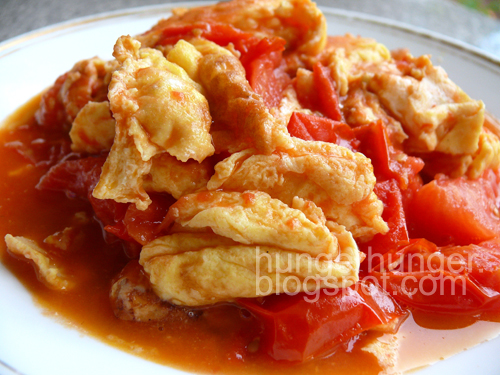
Tomato and egg stir fry

Tomato and scrambled egg has got to be one of the most common Chinese home dish. My mom's version is dryer with less tomatoes and the egg is thinner and less meatier. I prefer the version which I learnt from Hub's aunty in Shanghai because the eggs are fried into thicker pieces and soaked in a savory sweet tomato sauce. I thought I'd do a post on this since we had it for dinner tonight and since I've had requests for simple, easy to do dishes. This is an inexpensive dish that cooks in about 5 minutes and is delicious with plain rice. If you love tomatoes (like I do) and eggs, you'll love this dish. This is so simple to cook that I have nothing much to say so this will probably be my shortest post so far.

Tomato Egg Stir Fry

4 large ripe tomatoes (about 400 g)
5-6 large eggs
a shake of white pepper
1/4 t salt (or less, up to you)
1 1/2 -2 t caster sugar
2-3 T veg oil
pinch of msg or chicken granules (optional)

1. Cut the tomatoes into wedges. Remove skin by putting tomatoes in hot water for a few seconds, then peel and slice into wedges. Remove the seeds but not too completely. It's traditional to remove the seeds and skin but now I  don't do that because it's such a waste.  Crack the eggs into a bowl, add 1/8 t salt and white pepper and beat with a fork or a pair of chopsticks.

P1320112

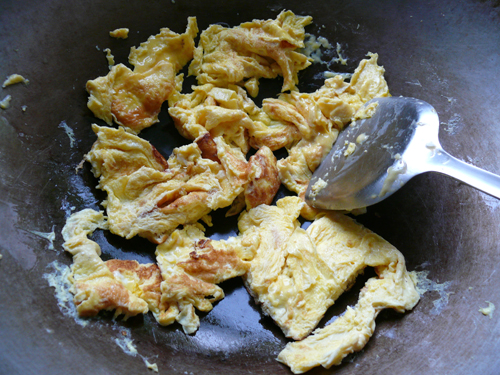
2. Put about 1 1/2 T oil in a heated wok or you can also use a skillet. Make sure the oil coats all the sides of the wok so the egg won't stick. Pour all the egg into the wok, wait a few seconds (heat at medium) and tilt the wok so that the egg pancake is bigger but don't make it too thin; you want a meatier bite. When the egg is half set, turn over. It's okay to turn over section by section; the egg doesn't have to be in one piece. Using your frying ladle, cut the egg up into large pieces. Remove onto a plate.

P1320114-1

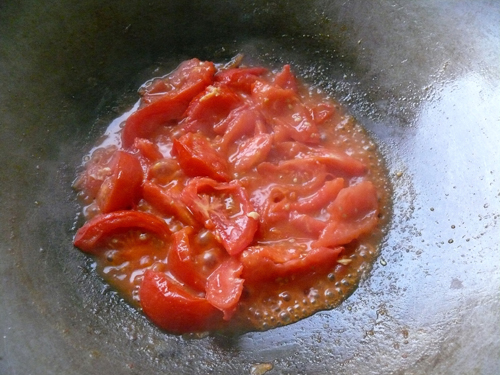
3. Put 1 T oil into the same unwashed wok, add the tomatoes, the remaining 1/8 t salt, sugar (some tomatoes may be more sour and need more sugar) and the msg/chicken granules if using. Fry under high heat, then when tomatoes are about half-wilted, add the egg, stirring well. Cover and lower the heat to medium-low and let simmer for 1-2 minutes to draw out the tomato juice and to let the eggs absorb the tomato juice.

4. Stir well so that the egg is fully soaked with the tomato liquid. If you like less sauce, increase heat to high so that the sauce dries up a little. Dish out into a deep plate and serve hot with plain rice.

Friday, April 24, 2009

New Man Tai, Bundusan

Beaufort and Tenom are towns on the west interior side of Sabah. These are towns where the Chinese Hakka immigrants settled in about 100 years ago. These towns have shrunk with the passing of the original batch of immigrants and their children and the migration of their grandchildren into the cities. Hakka food is simple, non-pretentious cuisine that centers on pork as the preferred meat: stir-fried veg with pork, pork mince stuffed tofu, boiled chicken, pork-egg rolls, stewed pork leg, cha sao omelette and so on.

With the coffee, rubber and fruits orchards owned by small-holders replaced by mega oil palm plantations, many of the interior Hakkas folks have moved to the city and opened up coffeeshop-style restaurants that serve Hakka food. These are bright , florescent-lit, no-frills, no air-con-type of restaurants that serve 'home-style' food, mostly stirred fried to your order. You'd know them by their names: Beaufort or Man Tai. There are at least one in each residential area and they are always full, with families waiting for their tables on the 5-foot way. In Penampang, there are two I know of: Restaurant Beaufort and New Man Tai in Bundusan. R. Beaufort is always overcrowded and littered with used tissue papers on the floor and for that reason I hate to go there. I now totally avoid the place because the last two times after I had dinner there, I came down with stomach aches both times. I don't miss it anyway; the food has gotten really bad, with shrinking portions and food so gluey you can mend your shoes with it.

My fav Hakka 'home food' restaurant is New Man Tai at Bundusan. It is less congested, the place seems cleaner and the food is marginally better than the other similar restaurants. That was my impression. Last Sunday, we were there for a quick dinner and I was surprised to find that it was rather expensive and the food lacked its trademark wok hei (heat of the wok). Overall, the food too was gluey and I realise that this glueyness is the other trademark of these Beaufort-type of restaurants.

P1320073

Fried noodles, Tenom-Beaufort style. RM5.50/US$1.50 per small plate . Wey couldn't finish this. He said Restaurant Beaufort's noodles are better.

P1320069

Bittergourd with beef and black beans, RM9/US$2.50 for small portion. Done pretty well except for the beef which had so much bicarb of soda as tenderizer it didn't have any beef flavor left. But then, that's always how beef is treated in Chinese restaurants--with a lot of bicarb of soda, because they use cheap tough cuts of beef.

P1320070

Tofu with minced pork and mushrooms, RM11/US$3.80 for small portion. Used to be better.

P1320074

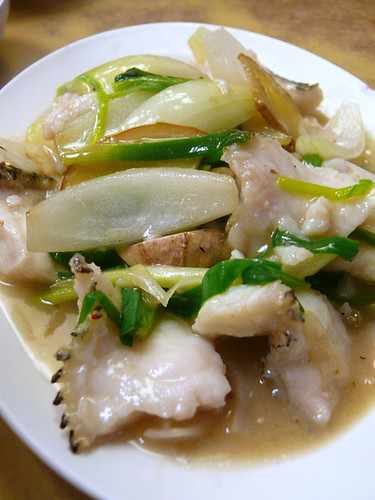
Fish with ginger and spring onions, RM16/US$4.40 small portion. Expensive! There were only about 10 small slices of flavorless fish.

P1320071

Small portion of mustard greens and pork stir-fry, RM9/US$2.50

Including the soup of the day (winter melon soup) and 3 plates of rice, the bill was RM61.40, not cheap for simple home-style food methinks. I came home with my mouth dry and numb from the msg in the food, a common feeling after eating at Beaufort/Man Tai restaurants. Msg is the life saver for Chinese restaurants. The stuff can spike up the savory sweetness of food especially if the ingredients are not fresh or of good quality. One tiny pinch of the stuff can enhance a whole plate of greens but many restaurants use it like they use salt and you can actually get used to it if you eat out often.

New Man Tai is next to Supertanker Restaurant, Jalan Bundusan, Penampang.

Thursday, April 23, 2009

Hangzhou West Lake Vinegar Fish

fish
Westlake vinegar fish. Double the amount of sauce if your fish is big. Here, I didn't have enough sauce and instead left half the steamed liquid on the plate--not very presentable.

When I was about 16, my oldest bro came back from college in Hong Kong where he had a Shanghainese girlfriend. He told us that he noticed two distinct things about the Shanghainese: their food is black from all that soy sauce and they have higher and sharper noses than us Cantonese. That made me check out every Shanghainese's nose, and unfortunately for them, I disagree with my bro's observation. Longer, just slightly longer noses, yes, but not any taller than the average Cantonese nose. Staturewise, however, they tend to be taller. But bro was right about the color of their food though. While Cantonese food is colorful with fresh ingredients, Shangainese food tend to be a boring brown-black, simmered and stewed in soy sauce, wine and sugar--the famous 'red-cooking'. However, I have to admit, color is deceptive and nobody red-cooks and braises and stews better than a Shanghainese.

The Cantonese way of cooking sweet and sour fish is to deep-fry the cornstarch-coated fish and blanket it with a sauce made of tomato ketchup, white vinegar and sugar, with some colorful veg thrown in. I find the white vinegar and ketchup too sharp, and so this is my least liked way of cooking sweet and sour fish. The Shanghainese way is to pan-fry the fish and finish the cooking with ginger, soy sauce, sugar, wine and black vinegar. The combination works very well except I find it a little too sweet. Hangzhou, a city 2 hours by car from Shanghai, is famous for several dishes and one of them is their Westlake vinegar fish, which uses similar ingredients as the Shanghainese vinegar & sugar fish, but the fish is poached, making the flesh softer, moister and less oily, perfect if you don't want to fry, and then, a sweet sour sauce is poured over it. I kid you not, this is one really yummy way of cooking sweet and sour fish. It's so good I prefer it to the Shanghainese sugar vinegar fish, and even my MIL agrees.

I've simplified the recipe for home cooks. Do you know that most restaurants poach instead of steam (but they'll tell you the fish is steamed) their fish? Poaching cuts down on the cooking time. The water the fish is poached in is probably seasoned to the point of becoming a fish stock since they poach so many fish. Hangzhou vinegar fish is usually poached but I prefer to steam it; saves the trouble of lifting the fish out from the water. We don't get good freshwater fish here, unlike in China where all the fish they eat are from rivers and lakes--Westlake is the most famous lake in China (I think. I'm not a sino expert) although all I remember of it was mist, mist, mist-- and are surprisingly flavorful and tasty,whereas the ones we get here taste of mud. Which is why we prefer salt water fish although in terms of flavor, good fresh water fish is better. The best fish to get for this recipe, if you can't get a good fresh water fish, is fine-fleshed fish like the perch, bass, barramundi etc of about 800g to 1 kg. Grouper is good too but it should be less than, say, 1.5 kg. Don't get filletted fish. Chinese prefer their fish whole, bones on, probably because chopsticks are the perfect tools for picking at the fish . I find filleted fish boring to eat. Besides, deboned fish is for sissies.

Hangzhou Westlake Vinegar Fish
1 x 800 g whole fish, butterflied*
1 T shao xin wine
2 T of very finely-cut strips of fresh ginger
about 2 T spring onion strips

The sauce:
3 T light soy sauce
4 T black vinegar
4 T brown sugar (for color & it's not as sweet as white sugar)
1/2 t salt
1 cup chicken or fish stock (step 3)

1/2 T corn flour
2 T water
--mix well

sesame oil (optional)

* update 18/11/10: after my recent trip to Hangzhou, I realize that the fish must be butterflied to minimize the cooking time so that the flesh is tender. The fish will also look bigger when butterflied.

1. Remove the scales & clean the fish. If fish is thick, butterfly it. Make a couple of slashes on the thickess part of the body to help fish cook faster. Put the fish on a heat-proof plate and scatter ginger strips under and over the fish. Pour the wine all over the fish.

2. Steam the fish for 10-12 minutes depending on the thickness of the body. Test with a fork by flaking the thickess part of the body. If it flakes off easily from the bone, fish is done. Do not over cook.

3. While fish is steaming, put all the sauce ingredients (except for the cornflour and water) into a small pot and cook over low flame, stirring to dissolve the sugar. When sugar is dissolved, add 1 cup chicken stock*/poaching water to the sauce. When sauce boils, add the corn flour solution and stir well until sauce becomes shiny and thickened. Taste and adjust with more sugar or vinegar or salt to your liking.

4. Add a splash of sesame oil (if using) to the thickened sauce and pour it over the steamed fish. Sprinkle the fine spring onions strips on the fish. Serve hot.

*Note step 3: You can use the liquid from the steamed fish instead of the chicken stock but it may be fishy & also turns the sauce opaque instead of shiny & clear.

Tuesday, April 21, 2009

Thank You God

As the readership of this blog grows, it gets harder for me to share my personal life. It is not 'cool' . But I think it is a blog first rather than some kind of professional publication. I don't want it to become some snob blog.

I realize that I am a worrier. I worry and worry and assume the worst so that when the worst is not as worse as I had imagined, I feel better.

Three weeks ago the doc said that my mom (who is now living with me, after a hypoglycemic scare in early March) needed further tests; she had blood in her stools and she was loosing weight. All my other problems pale in comparison. I thought how stupid I was to not appreciate simple things like watching TV with my family (instead of blogging) and sitting out with a cup of coffee when the weather's cool. I felt how brief and precious life was, and how I take it for granted. I think unless you are in a position where life can be touch and go, you will not fully appreciate it. I even felt depressed, and I thought maybe I should just give up blogging too because suddenly it wasn't fun anymore, in light of the seriousness of the situation. But I prayed and hoped that God will let me have my mom for many many more years. Wey realized how anxious I was and for once passed his BM test because he knew that would make me happy. Oh, the human penchant for complacency and the need to be shaken now and then.

I also realize that I've been living for the future. My future is 'when my kids graduate, when Wey gets into uni, when my dream house is completed, when Hub is retired, when we can pack up and go around the world'. When, when, when.

If you are reading this, and you are facing some problem that is not life-threatening, let me tell you to be happy, look at things differently, positively, gratefully and hopefully. When I was young, I prayed the hardest when I wrote a bad exam because that was what matters the most for me then. In the last 10 years, my hardest and most earnest prayers were for family and friends. Other times I'm a 30-seconds prayer person. Make that 60 seconds just in case my church friends are reading. Like what many others have said, that on their deathbeds, nobody regrets the loss of a business deal or the dream Mediterranean cruise or the movie star career. Most deathbed regrets are about estranged relationships.

Just thought I'll share with you how I'm feeling. If there's somebody you love, let them know. And be kind to them while you can. All the little squabbles, the little irritations, or even the big ones, they don't matter. If you love, and are loved, thank God and be grateful. That means showing them, not just saying it. For me, showing love can be holding back my tongue; I'm learning to be nice.

p.s the results are back. My mom has a non-cancerous ulcer in her colon. She is recovering. I know because she is asking silly irrelevant questions and started snooping in my kitchen (she just broke a tiny porcelain plate Yi had bought for me from Dresden, Germany, teaching/forcing me to let go of material things...). Most of all, she wants to eat everything, so I know she's back to normal.

As for me, I'm my old self. Somebody jumped the line at the Foh San traffic lights yesterday. Too bad for the fella, because of all the cars, he chose mine to squeeze in front of, so I fought him inch by inch until he gave up. I just won't allow people to jump the line like everybody else can wait but not them. No manners.
Related Posts Plugin for WordPress, Blogger...