Friday, March 22, 2013
Miri 1
Miri is a big town small city about 40 minutes by plane from Kota Kinabalu. Borneo Island looks sort of like the profile of a terrier, with its face towards the right. Miri is just a little bit further south of Brunei, a country famed for its wealth from oil and gas, and for the exciting lifestyles of its rulers. This is my first trip to Miri although 20 years ago I was nearly there when I spent a couple of days in the famous limestone caves of Miri called Mulu Caves. The caves are worth a visit. You can skip the town unless you like hot open spaces, chaotic roads, bad drivers and randomly located buildings.
Miri looks like it's on a booming roll, with thousands of new houses and super straight wide roads (envy). Other than the oil and gas industry, Miri's economy is fueled also by the presence of 3,500 Curtin University (of Australia) students. Beats me why anyone would want to spend four years seeking knowledge in a place like Miri but then who am I to judge, especially when my own son is enrolled there for foundation studies. I've always advised kids that university life is not just about studying, but also being exposed to different cultures and ideologies.
I was so looking forward to eating Fuzhou noodles; just love them. From the airport, we went straight to Hong Yung Cafe in Morsjaya, less than 10 minutes away.
Look at that, only RM4 for a bowl of noodles!
The people sitting at the next table were having this, steamed tofu with pork and salted fish, but it had to be pre-ordered a day before. Darn it, it looked good.
This is baiguogang, fried sticky rice noodles. It was yum. The Shanghainese has a different way of frying these noodles, here.
This is one of my fave Fuzhou noodles but this bowl of din bian hu was rather bland. It didn't have the deep flavor of pork bones and cuttlefish stock that lady at the Fuzhuo Association building in Kota Kinabalu used to serve.
Again, maybe because I was comparing all these noodle dishes to those I ate at the Fuzhuo Building in KK, I found this rather bland although I did like it because the fish balls were home-made and the sourish jowcai (a preserved veg) was refreshing.
Pork liver and heart soup. I ate a slice of liver; it was tender and tasty.
About 10 years ago, a friend used to bring delicious Sarawak kolo mee back to KK every Friday night. This plate of kolo mee is not as good as my favorite kolo mee in Inanam, KK.
It was an eating spree all day in Miri. We ate pork and taro buns at tea time but I wasn't impressed (the bao was fine and soft but the filling was just a bit of meat with lots of chopped onions held together by thick gravy. The taro filling looked dyed and tasted of cheap margarine) so I didn't bother with photos.
My son had a good meal at Mei Xiang Cafe (second shop on the right, Jalan Jee Foh Utama, Krokop) a couple of weeks ago and dreamt about eating the pork dishes again.
Midin is a fern that is to Sarawakians as sayur manis is to Sabahans: very loved and ubiquitous. The midin here was fried in rice wine--utterly delicious.
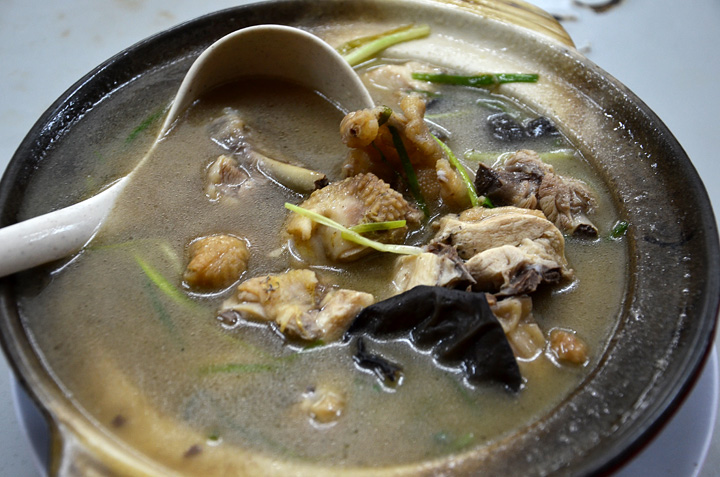
Another hit, chicken cooked in wine--awesome fragrance and flavor!
My son's fave dish, thin slices of pork belly fried with salted fish served piping hot in a claypot.
Pork belly slices fried with salt (joo rou chao yen). This tasted quite ordinary, like Korean samgyusal and it went well with rice.
House tofu.
A simple dish of bean sprouts with salted fish--crunchy sprouts, tasty sauce and a strong 'wok fire' made this the best dish to me.
The bill came to RM73.40 for 6 of us. No wonder Hub thinks Miri is great. I was not so sure because by the time we got to our car, my stomach was churning. I spent the whole night in discomfort. I couldn't figure out what--the lunch, the tea break or the dinner--caused the runs because only three of us got sick.
Labels:
Travel: Malaysia
Thursday, March 14, 2013
Taro & Pork Ribs Congee
I couldn't find taro in the market or supermarket so I waited for the Donggongon tamu (a local market that is held on Thurdays and Fridays in Donggongon). Look at the stuff I picked up there this morning:
Baby jicama, RM5 per kg.
An Indonesian fruit called salak, RM2 for all that.
Taro, RM4 per kg.
No idea what this is but it's sour and the vendor said it's for cooking fish. RM1 for all that.
Rm3 for the sweet corn (pretty expensive for 4 but this is Malaysia), RM2 for the limes, RM2 for the very fresh and young petola and RM1 for each bundle of tender Chinese spinach and long beans.
Baby jicama, RM5 per kg.
An Indonesian fruit called salak, RM2 for all that.
Taro, RM4 per kg.
No idea what this is but it's sour and the vendor said it's for cooking fish. RM1 for all that.
Rm3 for the sweet corn (pretty expensive for 4 but this is Malaysia), RM2 for the limes, RM2 for the very fresh and young petola and RM1 for each bundle of tender Chinese spinach and long beans.
When I got home from the market, the congee that Vero cooked was purplish in color. She had added pulut hitam (black glutinous rice) because we had run out of brown rice (we are mostly on brown rice now because my mom's diabetic). It was too wasteful to cook another pot of congee so I went with what Vero had cooked. When we sat down for lunch (congee for lunch in tropical weather is a big mistake), the kids wondered if the congee was savory or sweet.
Surprisingly, it was good congee. Taro never fails, never.
Taro & Pork Ribs Congee
400 to 500 g pork ribs, chopped into 3 cm pieces & blanched with boiling water & drained
400 to 500 gm taro, peeled and cut into chunks 3 cm square
1 1/2 cups white or brown rice, washed
2 cloves garlic, 1/4 of a small brown onion and a very small knob of fresh ginger, all smashed and chopped finely
1. In a heavy-based pot, fry the garlic, onion and ginger in about 1 tablespoon of veg oil until soft and fragrant but not brown. Add the rice and stir, then add water about 15 times the volume of the rice. Cover and simmer, stirring once in a while. Add more water to make the congee thinner if like. Note: Do not add water to ready cooked congee or it will turn watery when cold. Some congee purists (usually HK people) start with the right amount of water and never add anymore, controlling the consistency of the congee by controlling the heat.
2. After one hour, add the spare ribs and simmer again for 30 minutes. Usually, at this point, I like to turn the heat off and let the congee swell. If you are doing that, you can add the taro now. It will cook but if it doesnt go soft enough, go to Step 3.
3. Add the taro and simmer until the taro is tender but not too soft. Season with salt and pepper. Let congee steep for a while before serving.
Labels:
NoodlesNRice,
One Pot Cooking
Sunday, March 10, 2013
Subscribe to:
Posts (Atom)