Wednesday, October 20, 2010

Expo 2010 Shanghai

P1460287
The Chinese Pavilion was much bigger than I expected and rather awesome. The line getting into the provincial pavilions moved quickly but to get into the main pavilion, you'd have to spend hours to get in so we didn't bother to do so. Scalpers offered to sell tickets (the most popular pavilions issued tickets) for hundreds of Renmingbi.


P1460313\
Guilin, one of the better provincial pavilions.


I've heard nothing good about the Expo but we bought our air tickets early in the year so despite all the bad feed back from friends and our daughter who was there in blistering July and the fact that the first week of October is the National Golden Week on which the whole country is on holidays, we went anyway. We figured that by now the crowds would have diminished.

The only thing good was that the weather was pleasant at 24 C, lower at night. Our plan was to go after lunch and stay there until the end for the lights show but we were so tired and bored that we left at 7 pm. I was never enthusiastic about the World Expo anyway and this visit confirmed my decision: I'll never go to the World Expo again. It's tiring and boring. Fine if you are from the rural places/never been anywhere outside of your town/under 18/getting an Expo passport for hundreds of RMB stamped all with the stamps of as many countries as you can thrills you.

P1460361
Most of the signs were in Chinese, like these in the new subway station built solely for the Expo. How international is that.

P1460283
Do you know what this means?

P1460262
The guy whipped out his camera to take a photo and his wife asked if we knew what the sign meant in English. These Canadians only read Canadian.

DSC_0365
I found the English Pavilion scary to look at so I didn't get any nearer. Besides the queue according to the announcement was 4 hours. I've never queued more than a hour for anything and I sure don't want to do that to see some seeds.

P1460244
So what do you do when all the queues to the nice pavilions are 3 to 6 hours (the Saudi Arabian one is one of the top favorites, but queue SIX hours to get in?)? You get into the no-queue ones like Lithuania (or was it Slovenia?) and eat a delicious cold beets soup.

P1460243
"Er, what country this is?" I asked Hub and he wondered where my Russian went. Why do they flip their alphabets and how in the world do you pronounce that??

P1460337
We were on the way out when I saw this building that stood out with wood &  carvings: the Nepalese Pavilion. So homey.

P1460221
When you can't fight the giants, just make do by joining with all the other can't-fight countries. No queues for these.

P1040867
I would be proud if I was Singaporean.

P1040871
It tickled me that they always pitch Malaysia and Singapore against/next to each other, just to show the glaring difference I suppose. One's a modern advanced affluent country and the other a kampung. Btw, do we have to use the same model house everywhere? Athough as a citizen I could enter without lining up, I gave this a pass.

P1460282
I cringed when I saw the New Zealand Pavilion, which is near the Australian Pavilion. Another case of constantly being pitched against each other, although like Singapore, Australia just can't be bothered because it's way ahead.

P1040865
I didn't go in either. Do I want to line up for an hour to see an audio-visual show of a couple of kangaroos and Australian bedrock?

Every pavilion has a side entrance for their citizens and Hub joined in the small group going into the Canadian Pavilion. I sort of hung at the back of the group, not wanting to get caught. Someone started to sing "O Canada" and another showed his Canadian passport. We weren't asked; I think the pretty lady knew we were lurkers. She ushered us all in, saying "It's always so nice to meet fellow Canadians!" I whispered to Hub that I felt bad but he said we paid foreign students fees for four years and it's payback time for Canada. A little girl came up and gave us each a Canadian flag...

Like I said, I won't be going to anymore of these Expos. Do you really want to line up for hours just to see a big screen showing the scenery of places you've already been to? And if you think the pavilions look good, they actually are cheap-looking up close. So there. Waste of time.

Ma Ber Ber's Lunch

Ber ber as in 'uncle'; I can't spell pinyin well. Ma Berber and my FIL were friends since university where they read law. The cultural revolution had just begun when they graduated and they were not allowed to practice although after the cultural revolution Ma Berber became a very successful lawyer. Imagine that, a friendship that spans over 60 years, most of it across the seas, and includes their grown-up kids.

P1450890

P1450897
The long lines outside GMC daily for the braised meat and the savory buns jam up the walkway of this part of Huahai Lu.

P1450854
These savory meat buns must be so good that they are worth lining up for half a block away.

 Guang Ming Cun (GMC) is a long-established restaurant in SH, something like Nan Xing was to KK. We had eaten in GMC on previous trips but this time, I was totally surprised by the food--it was excellent!

There were lines outside the restaurant, one line (amazing that the Chinese actually queue) for the braised meat (pork, chicken, duck, pigeons, squid) and another for some kind of savory buns. I was curious about the buns because the line was long each time we passed the restaurant but I never got to eat the buns.

We had 6 cold dishes first:

P1450863
A refreshing and delicious dish of pork trotters, pig's tongue, chicken giblets, fried fish and soy beans soaked in hua tiao wine.

P1450859
Steamed pumpkin and black dates, a popular cold item.

P1450858
You bao xia, fried river shrimps in oil, a very Shanghainese dish.

P1450857
A delicious cold chicken dish with peanut sauce.

P1450860
Strips of veg and jellyfish.

P1450861
My favorite dish of the meal, the luya or braised duck. I was told that this is one of the top items in the restaurants; people line up for hours to buy this home. The sauce was just amazing. I wanted so much to ask what brand of soy sauce they used to make the sauce. It's all in the soy sauce because there wasn't much spices.

P1450880
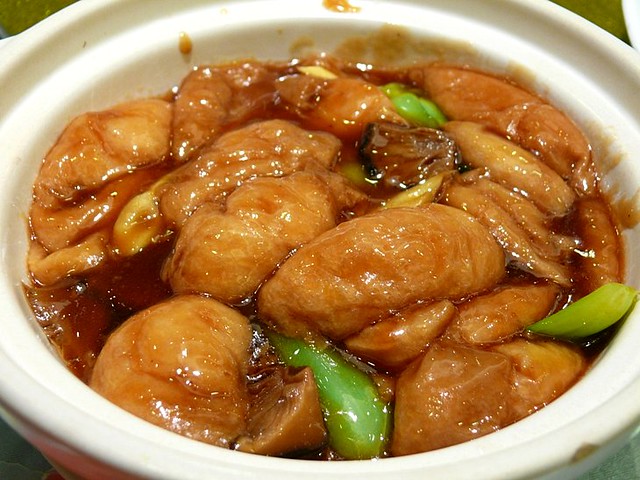
Stewed beef tendon casserole.

P1450874
Yee mien is new to Shanghainese because it's Cantonese noodles. These were a little thicker but done very well.

P1450868
A refreshing dish of tea tree mushrooms, shrimps and 'egg flower' ie egg whites.


P1450871
Tender beef with green peppers. Like the Spanish pimientos de padron, you never know which pepper is sweet or which is hot until you bite into one. Very delicious dish.

P1450881
This steamed flounder is the other top dish I loved. It was tender, smooth, sweet and full of flavor. The Chinese are obsessive about the freshness of their seafood, especially fish, which has to be alive just before they cook it. Because the fish is so fresh, it is a sin to cook it any other way. Steaming allows the sweetness and freshness of the fish to be savored. The top secret to excellent steamed fish is timing because the fish must not be overcooked. 

P1450872
Stinky moldy tofu is not my kind of food. I am convinced that craving or love for certain food is an acquired thing because how else do you explain why the Chinese love stinky tofu which smells worse than a clogged drain (yet 100% of the Chinese I met in China, even the kids, dislike cheese, even mild cheddar) and I bet 100% westerners dislike stinky tofu but love blue cheese which smells like bad feet? 

stinky tofu wey-1
My son Wey reacting to uncooked stinky tofu during our previous visit to SH four years ago.  I told you he has the most sensitive nose of anyone we know but even a stuffed nose can detect the awful stink of stinky tofu.

P1450875
Xi cai tofu soup, another very Shanghainese soup.

P1450870
This is men jin, a lightly fried tofu so tender inside that it melts in the mouth. Absolutely amazingly tender. I was examining each one before I popped it into my mouth. How do people make such glorious food?

P1450885
Sweet soup of red beans and 'lien xin' (lotus hearts--the seeds).

Copy of P1450884-2
The youngest person here is Xiao Shenshen on the right at 78. The rest are above 80 years and very healthy. It must be tofu; the Shanghainese love tofu.

The food was ordered by Xiao Shushu ('small/youngest paternal uncle', hub of Xiao Sensen, small aunty), Hub's youngest uncle in the middle of the photo, who's 80 and very humorous. Definitely young at heart and fun to be around with. Ma Berber and his wife are second and third right. Da Shenshen ('big aunty', wife of older uncle) is on the left. I learnt a lot about food when I dined with them. They talked about where to eat what to eat how to eat. The meal above for 7 only cost "just over RMB500" (RM300/USD94), much cheaper than the fancy new restaurants.

Tuesday, October 19, 2010

Mido's Lunch

Mido is Hub's cousin who is also Huiyi's cousin--get the connection? Their fathers are brothers, Mido's dad being the youngest, Huiyi's dad's the oldest and Hub's dad the middle one.

Mido's hub is a great cook, having paid for cooking lessons a long time ago with 'the original masters'. We were treated to a wonderful dinner at their home, also in a longtang, and there were 11 dishes including the soup and dessert, for 6 of us. We protested that there was too much food but by the end of the meal, only about 25% of what was laid on the table was left! I gained 1.3 kg in 7 days even though I didn't eat any rice (rice is usually not served when there are so many dishes) and walked more than  4 hours daily. At one point I swore I'll never go to SH again if they feed me like that (ungrateful huh) but looking at these photos, I wish I'm there again.

P1450767
What a delicious lunch! In case you wondered, the drink is cucumber and pear juice--I loved it. The Chinese like to snack on cucumbers, considered a cooling food, especially in the summer.

P1450754
Steamed bahyeh hohtui, Chinese ham slices steamed over fresh tofu sheets called bahyeh.

 I've never had this dish cooked this way--steamed--because my MIL usually makes a tasty soup called yindooxin, for special occasions.

Chinese ham (someone wrote me and said she/he was unaware of the existence of Chinese ham. Well, I'm not surprised if the Chinese were the first to make ham. They also have xen rou, salty pork, which is Chinese bacon)  is somewhat similar in flavor to parma ham but very different in texture--Chinese ham is dry, hard and coarser.

P1450744
Chopped boiled chicken with flavored salt.

This is regular boiled chicken but served with a dipping sauce made of a flavored salt mixed with sesame oil. You can use Season's Spicy Bake Mix and sprinkle it over the chopped chicken or if you don't mind the extra oil, lightly heat some sesame oil and pour into a spoonful of the said mix to make the dipping sauce.

P1450755
Fried gaobak.

It must be the season for these gaobak shoots because we had them at every meal. Lightly flavored with a soft crunch, this is a delicious veg best stir-fried.

P1450746
Luya, soy-braised duck.

This is one of the best ways to cook duck. I have a recipe which makes excellent luya too.

P1450756
Lotus root stuffed with glutinous rice in osmanthus syrup.

My MIL makes this sometimes and I've grown to like it especially on this trip where this dish appeared on the table many times. Mido's longtang house is newer and very pleasant, and while we were eating, the scent of osmanthus drifted in from her neighbor's tree. The air was cool, the long French doors with their gauzy curtains waved and it was just so nostalgic and beautiful. I wished the radio was playing some Shanghainese club music from the 40s but the TV was on instead.


P1450743
Crabs with asparagus


I told you the guy can cook.

P1450753
Steamed prawns on mung bean vermicelli.

I like this dish by Mido and I'm going to re-create it Thai-style. Isn't this a pretty way to present a simple dish of prawns?

P1450751
Stirfried fish.


I've forgotten the name of the fish but it was a live river fish, as all fish would be if you ate fish in China and Hong Kong. The Chinese are very particular about their seafood--it must be alive and jumping.

P1450762
Stir-fried sprouts.


At the market, I noticed that all the veg were very tender, most of them sprouts and young leaves. Kailan and choysum in western countries are as big as a tree branches (horror) but in Shanghai, they are less than the length of my palm. You'd want your veg to be tender so that they fry quickly without loosing their flavor and nutrients.

P1450749
Sichuan-inspired fish soup.


Mido said this was her version of 'water-cooked fish'. Instead of oil and fried chilies, she used home-made chicken stock because her parents couldn't eat hot spicy food. Hmm, since they don't have access to blogs outside the country (and Google &YouTube), I can say here that Mido's version is a tasty fish soup but nothing exciting like the real Sichuan 'water-cooked' fish. I like the fen pi (clear flat noodles) she added to the soup.

P1450773
Tang yuen with jiu niang and osmanthus.


Jiu niang is glutinous rice in the process of fermenting into rice wine. My FIL loves this and wanted us to bring some home but liquid being banned on flights prevented us from carrying some home.

Mido's lunch (yes, 11 dishes for lunch) taught me that when entertaining dinner guests, I should cook more variety of dishes in smaller amounts instead of cooking about 6 or 7 big dishes. It's more work and Chinese dinners are harder on the cook than western dinners because the dishes have to be fried and served immediately  which is stressful and leaves you hot with an oily, shiny face but makes your guests feel pampered.

Sunday, October 17, 2010

Shanghai

On our third night in SH, we were about to go to bed after coming home from dinner when 7th Uncle (younger bro of my MIL. In China, each child is numbered according to his birth order. My MIL for example, is 'si jie', 4th sister, the 4th to be born) mentioned how the lights would be very pretty at The Bund, as it was National Day Golden Week, so we jumped into a taxi which brought us there in less than 15 minutes.

SH lies at the mouth of the Huangpu (tributary of the Yangtze, the longest river of China) which cuts the city into the older area Puxi and the newer area Pudong.The English name for the beautiful stretch of river embankment where the two areas are sited is The Bund, which I find stupid-sounding. I prefer the Chinese name Wai Tan which means 'outer beach'. Sounds so much more romantic and less stupid.

P1450707
On The Bund, looking at the modern Pudong side with the futuristic Oriental Pearl Tower on the left and on the extreme right, the current highest building in China, the Shanghai World Financial Tower. 

Shang means 'up' and hai means 'sea'. Interestingly, in Chinese you don't fall in love, you 'up love' so the words on the building is a play on the city's name: 'Fall up up sea' means to fall in love with Shanghai. Hub's grandparents were from Pudong, in those days an undeveloped area of SH. Now Pudong is the high-class business center of the city.

P1450725
On The Bund, looking at Puxi  on the left.

Puxi on The Bund is lined with neoclassical buildings built a century ago. These are now mostly headquarters of international banks.

P1450776
Nanjing Rd

I thought I could escape Nanjing Rd, a very tourist-packed pedestrian street. Don't waste your time here. Nanjing West Rd however is an upscale and pleasant street to stroll in, especially at night. Shanghai this time of the year is filled with the scent of osmanthus (guihua) but  it gave me headaches and sniffles. The scent of magnolias on Nanjing West Rd agreed with me and in the cool night (about 19 C, no need even for a sweater), we had one of our best walks. We couldn't afford the things on Nanjing West Rd so we stopped by a cart that sold English paperbacks. We picked three for RMB70/RM35/USD11 and didn't realize until we got home (it was too dark on the street corner) that they were pirated books. I didn't know that they pirate books too. It felt wrong.

P1450903
Huahai Lu which we had to walk daily since hub's relatives lived off the road, in the longtang behind Starbucks in fact.

I found Maoming Lu and Shanxi Lu best for shopping. Changle Lu had surprisingly nice apparel but prices are crazy. I don't do malls such as those in Xujiahui; too boring.

P1040630

Longtang (in Beijing, they are called hutang) are 3-storey brick townhouses over 100 years old, usually grouped in a small area with two exits/entrances, one in the front and one at the back and guarded by a watchman each. Generations have grown up in longtangs. Not many are left in Shanghai. This one is Huahaifang, just behind Starbucks on Huahai Lu, where my MIL's three brothers live.The houses are old but because of their location, each house is estimated to be worth RMB10 million/RM5 million/USD1.6 million! The owners don't renovate their houses because they are waiting for the government to take over.

I prefer longtangs to apartments because there's a sense of community and kids can play with each other on the lanes where no cars are allowed. Most families now live in apartments where kids are confined and neighbors don't know each other. The lucky ones who live in longtangs are usually those 'real' Shanghainese whose ancestors first moved there.

P1040824

This is the staircase and landing of my FIL's brothers' longtang in Tungfuli, behind Changle Lu. The rooms are huge and the ceilings over 11 feet high. There's no central heating and in the winter, these houses are bitterly cold. On our first trip to SH, we stayed in the attic and despite 5 layers of comforters, we froze every night. There's a charm about these old houses. They remind me of the houses I stayed in in New York and Toronto a long time ago. It's a pity that they will be torn down soon. Because of that and our wanting to spend more time with Hub's uncles and aunties who are in their 80s, we decided to stay in their longtang this trip.

P1450795
Tianzifang, Taikang Rd.

But there's good news. Not all the longtangs will be demolished. This is Tianzifang, a longtang that now houses art galleries, boutiques, pubs, restaurants and other shops. The houses are maintained as much as possible and I think they did a great job at that. However, I feel that Tianzifang is too westernized. Instead of Chinese music, American pop music was played and the restaurants seem to all serve western food such as pizzas and steaks. Things were super expensive there.

P1450839

I was fascinated by the way this building was decorated. The 3-D petals looked very pretty as the lights changed. The buildings on Taikang Rd are modern and new and many are art galleries like this one.

P1450830

Why not stroll before bedtime in your pjs and jump into bed without changing? Wearing your pjs publicly is a very Shanghainese thing and the government banned it during the Expo period but I saw many people in pjs, most of them men. Women used to leave the house with their hair in rollers but I didn't see that this trip. Wearing pjs in public is not confined to old men only. One morning we were eating breakfast at 9 am and a young man in his 20s walked into the restaurant in his pjs. Straight out of bed, no need to get dressed. While at a major hospital one day because Hub had a pain in his arm, I saw a gweilo ('devil man', referring to white men but this term is now used fondly) walk in in his pjs. When in Shanghai, do as the Shanghainese do. Just make sure your pjs are nice.
Related Posts Plugin for WordPress, Blogger...